
Church of Scotland's General Assembly apologises for Kirk's past involvement in slavery
Apology must lead to ‘partnership of respect’ says Nigerian church leader
The Church of Scotland has issued a formal apology for its historical role in slavery.
The apology was adopted at the church's General Assembly in Edinburgh on Saturday.

Before the abolition of slavery in the British Empire in the 1830s, some members of the Church of Scotland offered a theological justification for chattel slavery, which treated human beings as personal property
The Kirk has also recognised that historically some of its members would have benefited from direct and indirect participation in the slave trade.
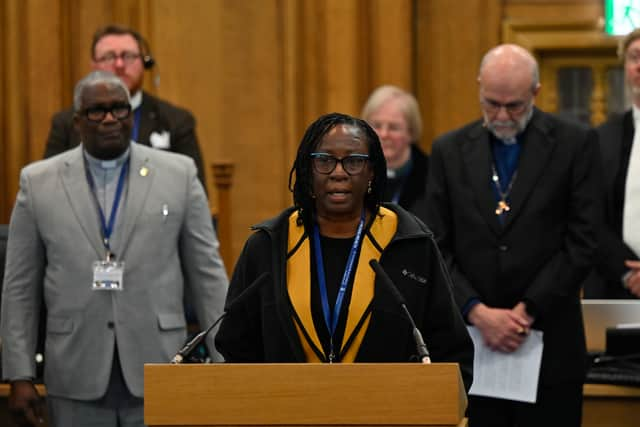
The Very Rev Sally Foster-Fulton presented the apology to the General Assembly.
She said: "The history we consider today continues to shape our world in ways we cannot ignore. Its consequences touch communities near and far, influencing the structures, attitudes and inequalities that persist around us.
"The legacy of slavery stretches like a shadow over our local, national and global landscape. Naming that is not about blame, but about faithfulness - about recognising that healing begins where truth is spoken."
The apology says that the Kirk is "grieved beyond telling by the extraordinary suffering we have inflicted - through our actions and our inaction - on our brothers and sisters".
It adds: "We repent, committing ourselves to changing course and bearing fruit worthy of repentance."
The General Assembly also committed the Kirk to create a new working group to recommend appropriate next steps. The group will work in partnership with those who continue to be affected by the legacies of slavery.
Several overseas delegates from Africa and the Caribbean were present at the Assembly and responded to the apology and report.
Rose Wedderburn, general secretary of the United Church in Jamaica and the Cayman Islands, commended the “courage” needed to acknowledge wrong.
She said: “For many in the Church of Scotland, this report has been an eye opener. While the process has understandably evoked deep emotions, the effort invested in truth-telling and honest engagement is worthwhile.
“And we pray it will continue to bear fruit in greater understanding, healing, justice and reconciliation.”
And His Eminence Dr Ekpenyong Akpanika, Prelate and Moderator of the Presbyterian Church of Nigeria, said that having listened to the debate he had confidence that the Church was moving “in the right direction”.
He called for a reset in relationships between churches in different parts of the world. “Real acknowledgement should lead to real repair and better relationships,” he said.
“For this to happen churches in the global north and the global south need to move past all patterns of control and build a partnership of respect, shared leadership, justice and equality. True reconciliation takes more than just words.”
A number of institutions in Scotland have issued apologies for historical links with slavery, including Edinburgh council, which did so in 2022.