
New musical inspired by life and legend of The Great Lafayette who died while performing at Edinburgh's Festival Theatre

115 years to the day of his death, a brand new musical is set to unearth the great magician’s story once again
A musical is in the works inspired by the life and legend of The Great Lafayette, an illusionist who died after a fire erupted onstage during an Edinburgh show at what is now the Festival Theatre.

It was on May 9, 1911 that Sigmund Neuberger, famed throughout the world as The Great Lafayette, took to the stage of the Nicolson Street venue to perform the illusion to his 3,000 strong audience.
The German performer’s illusion Lion’s Bride was to be the spectacular finale of his sell-out performance at what was then called the Empire Palace Theatre.
But on this occasion, an electrical spark, high above the stage, brought the show to a tragic conclusion when Neuberger was among 11 members of his company who died in the theatre fire.
The new musical, presented by Helen Milne Productions and supported by Capital Theatres and Creative Scotland, remains a work in progress production.
It is being written and directed by John Binnie, with music and lyrics by Richard Ferguson, and illusion/puppetry design by Fergus Dunnet.
A work in progress performance of Lafayette: A New Musical will be seen at the Studio Theatre on May 9 at 7.30pm.
Describing the show, their website reads: “Blending bold storytelling, breath-taking moments of illusion and a soaring original score, Lafayette explores the cost of greatness and asks what must be sacrificed to become unforgettable.”
Sigmund Neuberger was born in Munich in 1871, heading to America in 1884 and by the age of 19, he was already performing on the stage.
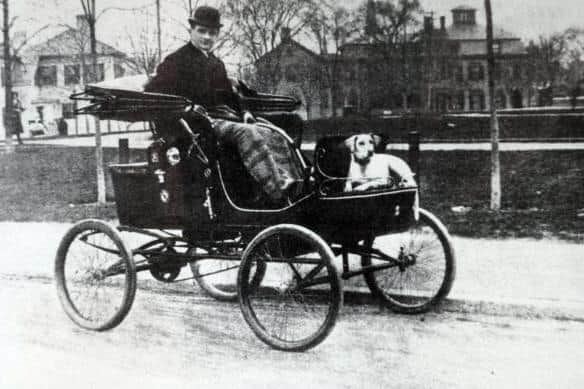
He soon became a popular illusionist, touring the USA and becoming friends with the legendary Harry Houdini. It was Houdini who gifted Neuberger his beloved dog, Beauty, who was pampered with five course meals and wore real diamonds on her collar.
At 14-years-old, on May 4, Beauty died just days after Neuberger arrived in Edinburgh for his tour.
He negotiated with the council, who eventually allowed the dog to be buried in Piershill Cemetery, on the condition that the magician himself would also be buried there when the time came.
Only days later, on the day of the show on May 9, 1911, a fire had broken out when a lamp used as part of the final trick set alight the stage.
Thinking the flames were just another special effect, the audience were unaware of the horror unfolding, as were those on stage.

When they attempted to lower the fire curtain it jammed three feet from the bottom. This sucked air in via the chimney effect, which fed the fire and made it worse.
When the fire started it wasn’t until the band started playing God Save the King that people realised something was wrong, initially they thought it was part of the elaborate staging.
Neuberger died when, having already escaped the flames, he returned to rescue his horse.
The Great Lafayette’s body was found and taken through to Glasgow and cremated.
He was due to be interred in Piershill Cemetery between the embalmed paws of his beloved dog, Beauty, who had died nine days prior.
Two days before the burial, work was still going on at the Palace Empire Theatre and as it did they found The Great Lafayette’s body for a second time.
This one, however, was different, it bore his elaborate jewels and rings which had been missing from the previous body, a fact his manager had noted, suspecting someone had stolen the expensive items from the body.
The second find turned out to indeed be the real Lafayette.
The first to be discovered was revealed to be the body of his band leader who was also used as a body double.
When he was buried, 250,000 people came out to watch his funeral procession.
One result of the tragedy saw a change in the law by introducing The Lafayette Bill brought in the lowering and raising of the safety curtain at every performance to ensure it is fully working and will do its job in the event of an incident.