
Are hybrid attacks by Russia already threatening UK security? - Bruce Whitehead
Every September a convoy from volunteers of the British Army's 2 (City of Dundee) Signal Squadron leaves a warehouse in Dundee to drive to a disused airfield near Thirsk in Yorkshire to test a doomsday machine worthy of Peter Sellers' insane Dr Strangelove character.
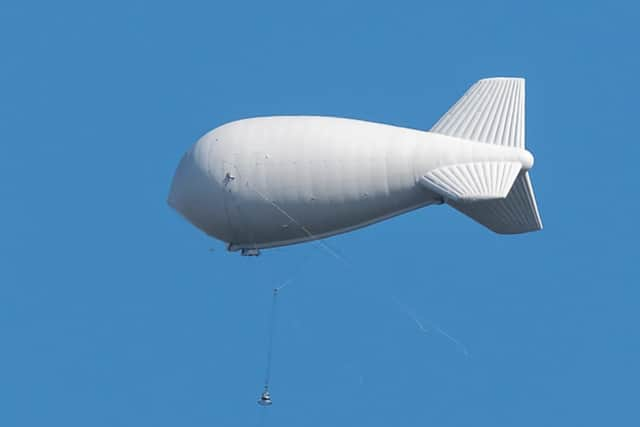
The team of reservists assemble what one described as an Ikea flatpack, to produce a "blimp" or Aerostat, which will lift an enormous VLF (Very Low Frequency) radio aerial to test the United Kingdom's nuclear deterrent fire control system.

In a nuclear war, constantly patrolling Trident submarines carrying ballistic weapons are contacted by the Prime Minister, using secret PINDAR communications systems to order any retaliation.
But if PINDAR is destroyed in a first strike, the Dundee backup system has orders to flee for the hills to deploy the blimp, allowing a backup fire control authority to contact the subs.
Three weeks ago the balloon went up, so to speak, and locals posted images on social media, most believing it was just a weather balloon. But suddenly the Aerostat collapsed and plummeted into a field.
The "failsafe" backup system for launching Britain's nuclear weapons had failed - and the mainstream media hasn't shared a whisper about it.
You may feel that this is something better left to military leaders, the Prime Minister Andy Burnham and Defence Secretary Wes Streeting. But whether you support nuclear weapons or oppose them, surely we deserve to know whether ours work or not? Or more importantly whether our potential enemies believe they will work?
Which brings us to the worrying circumstances of the Aerostat destruction, for which I am indebted to the work of the veteran security and defence journalist Duncan Campbell.
His 1983 book "War Plan UK" exposed the myth of deterrence which relied on nuclear bunkers, like the Edinburgh one at Barnton Quarry, designed to protect key personnel after a nuclear strike so they could retaliate.
Campbell argued the entire scheme was a deception, because the military chiefs knew there would be no survivors.
This week during a sneak preview of his upcoming book, The Decoy Game, Mr Campbell told an Edinburgh National Union of Journalists meeting he believes there is a strong likelihood that sabotage was responsible for the Thirsk Aerostat collapse.
"[The pictures show that] the balloon has been deflated at altitude. And the more that started to come in, the more obvious it seemed that this could be no accident."
Mr Campbell says that given recent drone attacks attributed to Russia across Europe at airports and other targets, and suspicious activity by Russian naval vessels, a discussion is needed about whether this was indeed another hybrid attack ordered by President Putin.
So far the Ministry of Defence has refused to comment. But if Wes Streeting succeeds in persuading the chancellor John Healy to cough up billions more in military spending (the goal is to boost it to 3.5 per cent of Britain's output) then we need to know how it will be spent.
As Duncan Campbell says: "We need a discussion about whether this was another Russian hybrid attack, where it is taking us and where in two years time, resources could be used most efficiently."