
Book Festival sponsorship blow may become a Pyrrhic victory - Angus Robertson
Philanthropy and charitable support is crucial to Scotland’s cultural life and arts infrastructure.
Ever since Andrew Carnegie left his mark it should be obvious how important benefactors are in building and sustaining the culture sector and educational opportunity for many Scots.

In many ways Carnegie set the bar for philanthropy throughout the world. Born in 1835 in Dunfermline, he grew up in a weaver’s cottage, before leaving Scotland for the United States as a 12 year-old in 1848.
Carnegie would go on to make it big in railroads and related industries including coal, oil and steel. By the turn of the century in 1900 more than half of the steel manufactured in the USA was produced by the Carnegie Steel Company. Following a number of mergers the firm became US Steel. It was the world’s first billion-dollar company and Andrew Carnegie was extremely wealthy.
Carnegie never forgot where he came from and never wavered from his commitment to education, life-long learning and access to books and knowledge. He famously said: “No millionaire will go wrong… who chooses to establish a free library in any community that is willing to maintain and develop it”.
He went on to fund more than 2500 libraries throughout the English-speaking world, the first in his hometown of Dunfermline, with others including Central Library in Edinburgh, the first public library in the Capital.
Towards the end of his life Andrew Carnegie donated the equivalent of over $6 billion dollars in today’s value to charities, foundations and universities and established the Carnegie Trust for the Universities of Scotland and the Carnegie United Kingdom Trust.
Since then foundations, charities and benefactors have kept up the good work, supporting venues, organisations and individuals. In Scotland there is hardly a cultural or educational organisation that doesn’t rely in small or large part to financial support given in addition to funds provided by local and national government(s) or the National Lottery Heritage Fund.
Whether it is the likes of the V&A in Dundee or Edinburgh’s world-class festivals, the support of philanthropy is crucial.
In recent years supporters of culture like Edinburgh-headquartered investment managers Baillie Gifford, the Dunard Trust and many others have played a vital role in supporting the arts in Scotland.
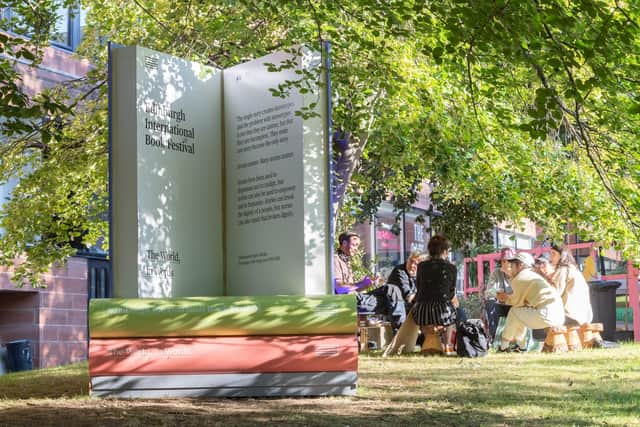
All of this underlines the seriousness of the recent dropping of sponsorship to the Edinburgh International Book Festival following a boycott campaign targeting the EIBF. This led to dozens of Scotland’s top writers and cultural figures writing an open letter criticising the "perverse” and “deeply retrograde” impact of protests against the sponsorship of the book festival by Baillie Gifford.
They wrote: “As citizens, we are absolutely right to keep up the pressure for fossil fuel divestment. We also call for an immediate ceasefire in Gaza and for the release of hostages. However, a strategy of protest which results in EIBF being left without a principal sponsor will jeopardise its future: this would be a Pyrrhic victory, and merely deprive writers and activists of platform and influence”.
I totally agree that the importance of the climate emergency, the appalling situation in Gaza as well as the invasion of Ukraine raise important ethical tests for funders.
These however, should be settled through dialogue and agreement which do not undermine the culture sector, including festivals like the Edinburgh International Book Festival.