
My Scotland is a place of welcome and hope - Ewan Aitken
My first school was Nairobi Primary in Kenya. I was statistically in an ethnic minority.
Although given all the teachers were white and I largely lived among an expat community who held significant power and status in Kenyan society at that time, it was very different experience to those in Scotland who would fall into the category of ethnic minority.

As a consequence, it was only when I returned with my family to live in Dunfermline I felt I didn’t fit in or belong. Never having lived in Scotland, I struggled with language, accent, cultural references and a limited ability to play football.
Despite my best attempts, I have never overcome the latter! It took me a long time to feel I belonged, despite knowing I was Scottish by heritage and my ethnicity meant I did not look different, even though I felt it.
Difficult as those experiences were, I am grateful for them. It taught me about the power of difference, how it is something to be celebrated. I discovered how it is in acknowledging difference, we discover who we are.
It is why I am proudly Scottish, but understand the truth that Scottishness as an identify is not limited to those born here or whose skin is a particular colour. A journey to belong to a place and a community does not begin solely with geography.
Years later, when I was a minister in South Leith Church, I discovered in the Kirk Sesson minutes from the 16th century mention of a free black family living and working in Leith.
The minute notes “Ane Blak man with his wyff and bairn is dwelling within Leith”. There is evidence of people of African descent being present in Scotland even earlier, including free individuals in the court of James IV in the 15th century. They and their descendants are as Scottish as I am.
Recent misinformation following a violent incident - which a very small number used to create a narrative of hate against those who do not fit a particular picture of what it is to be Scottish – needs to be called out for what it is; anti-Scottish.
Same with the attempts last year to associate the saltire with a similar brand of divisive identity.
These are turbulent times economically, environmentally and socially. In Scotland and overseas. It’s often hard to know how to make sense of it all. We can’t fix it but we can make choices about the things we do have power over.
The thing we can most influence is the communities we live in. We can choose to make them places of welcome and hope or division and hate.
In a complicated, complex and fragile world, it’s not difficult to see which is the wiser approach. And it can begin with the simplest of things.
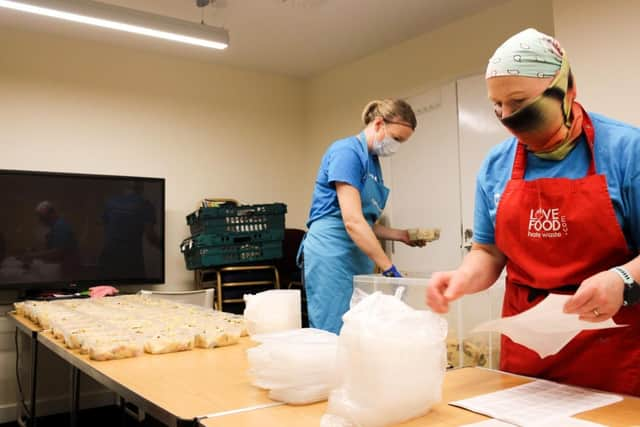
Last week Cyrenians held a community meal in our cook school in Leith to mark Commonwealth Day. Well over 50 people of all ages from a wide variety of backgrounds and ethnicities gathered to eat, talk, and celebrate being neighbours.
All of them left with smiles of their faces, with full stomachs and an even fuller sense that Scotland (and Leith!) was where they belonged.
That is the Scotland I love and what I want others, whatever their journey, to be welcomed into.