
How the Scottish Parliament changes at every election
Each session of the Scottish Parliament has had a unique aspect
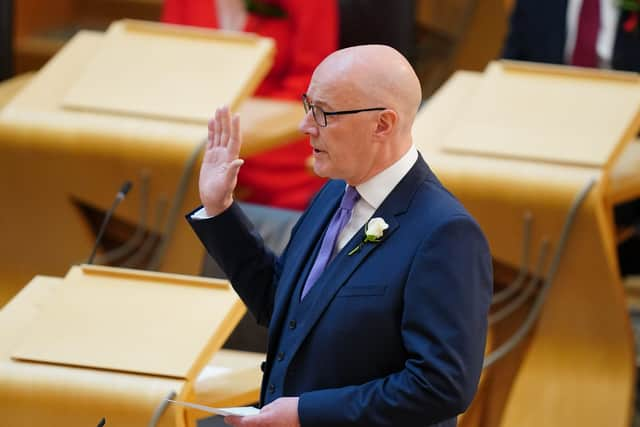
John Swinney will be elected as First Minister today when MSPs gather for the second week of the Scottish Parliament's new session.
But apart from a familiar face leading the government, it's all change at Holyrood. There's already a new Presiding Officer, long-serving MSP Kenny Gibson, who wants to "liven up" the parliament.

After two terms with the Conservatives as the main opposition party, that role is now shared by Labour and Reform, on level-pegging.
And the numbers are such that the support of any one party - even the Lib Dems as the smallest group - would be enough to give the SNP a majority for votes in the chamber.
So far, every session since the parliament was established in 1999 has been different from the last.
In the first session, with a Labour-Lib Dem coalition, everything was new as Scotland set about making its own laws.
The coalition continued after the 2003 elections, but there was a dramatic change in the make-up of the parliament, with Labour and the SNP both falling in numbers and the rise of the Greens and Scottish Socialists, as well as four independents, creating the "rainbow parliament".
The parliament elected in 2007 saw the rainbow largely disappear and the SNP came to power for the first time, after winning 47 seats to Labour's 46. Significantly short of a majority, the SNP minority government was not expected to last long but survived the full term.
The 2011 election was the SNP's biggest triumph, winning an overall majority of the seats in the parliament despite a system designed to make such an outcome almost impossible. It paved the way for the 2014 independence referendum.
In 2016, the SNP was returned as by far the largest party but without an overall majority and it resumed minority rule. But the Tories, under Ruth Davidson, replaced Labour as the main opposition party for the first time.
And in 2021, there was minimal change in the party's relative strengths, but in a new move Nicola Sturgeon negotiated a power-sharing deal - short of a full coalition - with the Greens to ensure the government would not be defeated on key votes.
Now, in 2026, the major change is the arrival of Reform - and what that will mean is the great unknown of the new parliament.