
'It was organised chaos': Retired East Lothian air traffic controller looks back on 9/11 from the Prestwick control room

Jim Brunton worked at air traffic control for 34 years and has looked back on the impact of 9/11 terror attacks.
It was the day the world stood still, but for staff at one air traffic control room in Prestwick all hands were on deck.
As news travelled around the world that two planes had crashed into the Twin Towers at the World Trade Centre in New York City on September 11, 2001, work was going on back in Scotland to help manage the world’s air traffic amid the ongoing situation.
Jim Brunton, a retired air traffic control supervisor from East Lothian, was working in the training section of the National Air Traffic Services (NATS) control centre at Glasgow Prestwick Airport on the day of the attacks.
The Prestwick NATS station dealt with flights from Birmingham northwards, as well as flights travelling between the United Kingdom and the United States.
The first plane hit the North Tower at 8:45am local time in New York City, followed by the South Tower being hit at 9.03am. Within the hour, an aircraft was also flown into the Pentagon building in Virginia. At 10.03am, a final plane crashed into a field in Pennsylvania.
It was around 2pm in Prestwick when the afternoon turned into “organised chaos”.
Mr Brunton, now 58, said: “It was a bit strange because I was in the office and somebody passed by and said there's been a major incident in America.
“We went and looked on the TV in one of the rest rooms, and it was CNN saying there’s been this massive event and America may declare themselves to be closing the airspace.”


He continued: “We had tried to contact America, because we did have a phone line to New York, but obviously, they were obviously up to their eyes, and understandably so, from what was going on. So they didn't actually answer the telephone.
“There was a real bit of confusion about what could possibly be the ramifications of what just happened. At that point, nobody had actually officially said America was going to close the air traffic. It was all speculation.”
The team at Prestwick were preparing with extra staff being drafted in in anticipation of the news that the airspace had closed, which came later that afternoon.

Work began on directing not only flights that had been due to depart, but also those already halfway across the Atlantic Ocean.
Mr Brunton, who retired last year after a 34-year career at air traffic control, said: “At that time of the day, half of the aircraft were halfway over the ocean, and half of them were approaching the Atlantic Ocean.
“We basically had to put a stop on aircraft that were going to enter and aircraft that were above the ocean, we had to ask them all to contact their companies because we can't tell them what to do.
“Bearing in mind that all of the aircraft flying over were heavy aircraft like jumbo jets and 747s, real transatlantic stuff. There were three options for pilots, they could continue to America in the hope that it would open back up, they could divert to Canada, or they could turn around and adopt an emergency procedure.
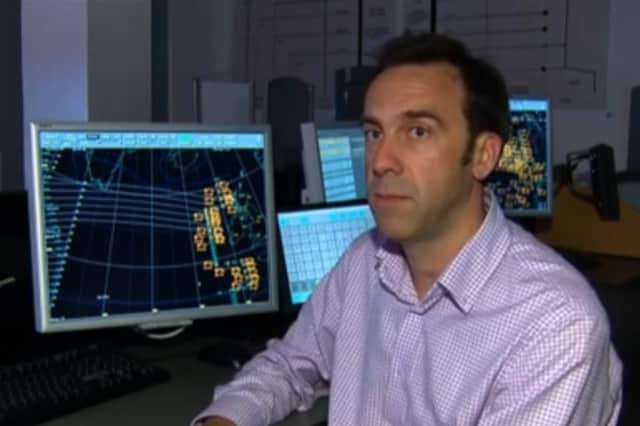
“We were just having to constantly react. One minute a pilot would say they were turning on an emergency procedure, then another aircraft would request a clearance to return, and another aircraft would say, no, we're going to continue. So we just had to react.
“Air traffic is all about planning but this was just reactive controlling all the time, and it changed minute-by-minute.”
After three-and-a-half hours of frenzy, the NATS team at the Prestwick centre had a handle on the never-seen-before situation, which itself would go on to shape future procedures.
Mr Bunton said: “We definitely took on board that these catastrophic events could happen and before that we had trained on things like total system failures and things like that so we knew how to ‘clear the skies’, as we called it. It was just that we hadn't simulated a whole country closing their airspace and everybody having to do what they did.”