
SEPA accused of blaming seagulls over sewage as Musselburgh beach handed lowest possible water quality rating

Concerns have been raised about persistent problems with sewage at the beach
Residents have accused Scotland’s environmental regulator of blaming seagulls instead of sewage after a popular beach in Musselburgh was given the lowest possible rating for water quality.
Fisherrow Sands, the sandy bay next to Fisherrow Harbour, has been classified as “Poor” for water quality ahead of the 2026 season, based on monitoring data collected by Scottish Environment Protection Agency (SEPA) over the last three years.
The site previously lost its status as a designated bathing water in 2019, following several years of water quality test results which showed that the water contained unsafe levels of E.Coli or Intestinal Enterococci.
This was due to problems with the infrastructure at the nearby Eastfield pumping station - where wastewater from Edinburgh is transferred to a sewage treatment plant - which resulted in excessive levels of sewage being spilled into the Brunstane Burn.
In 2023, the beach had its bathing water status returned following improvement works undertaken by Scottish Water, the Scottish Government and SEPA, and was reclassified as ‘Good’.
The improvements included fixing misconnections, blockages and structural defects in the sewage network.
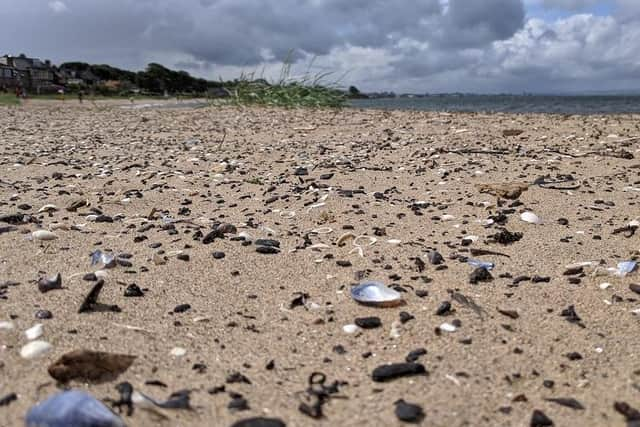

But after its brief uprating, the beach was once again classified as ‘Poor’ in 2024 and 2025.
Despite the historic problems with sewage, SEPA insists there is “nothing to indicate” that sewage contributed to the high sample results recorded in the last two years.
A spokesperson for the agency said the poor classification in 2024 was driven by a single, very high sample result, for which no clear cause was identified.
Meanwhile, they said in 2025, microbial source tracking indicated a high sample result was likely due to contamination from gulls.
But residents and political representatives in Musselburgh have said persistent problems with sewage cannot be ignored, and have accused SEPA of blaming other factors rather than face up to the issue.
David Wilkie, who chairs the Fisherrow Harbour and Seafront Association, said SEPA’s explanations for the poor ratings “simply don’t roll” and said the improvement work carried out in recent years had made “little difference”.
“I go out sailing regularly and there’s still a scum on the surface,” he said.
“It’s exactly the same issues. I speak to people who do the beach cleaning and three quarters of the stuff they collect is wet wipes, which are directly delivered out of the sewage system.”
He continued: “They’ve blamed the prevailing wind, sailors dumping sewage tanks into the water, and now the seagulls too - it’s absolute nonsense.”
“I’ve been left not able to believe a word of what is told to me about water quality, and my advice to anyone is don’t swim in that water.

“I think there is still a lot of sewage coming down the BookerBurn (the local name for the Brunstane Burn) that we know nothing about, and I think periodically the River Esk also contributes a significant amount.”
A spokesperson for SEPA said: “Based on the evidence available, there is nothing to indicate that sewage overflows have been responsible for the high samples that contributed to the current classification.
“Monitoring during the 2026 bathing water season will continue, and assessment against a full four-year dataset at the end of the season will provide a clearer picture of longer-term trends at the site.”
In response to the classification, Chris Murray, the Labour MP for Edinburgh East and Musselburgh, accused SEPA of being a “lackey organisation of the SNP Government” and claimed it would “rather blame dogs and seagulls” for the pollution at Fisherrow Sands.
He said: “I have attended multiple litter picks on Fisherrow Sands, with groups like the Seabird Centre – and have personally collected bags of wet wipes and sanitary products from the beach.
“This proved the problem is sewage.”
He added: “This rating simply must come as a wakeup call for Scottish Water and the Scottish Government.
“This is now the third year in a row the beach has been deemed inadequate.
“England and Wales monitor 100% of their storm overflows and make the data available. Scotland monitors 34%.”
“This is a government failure.”

Katherine Sangster, the Scottish Labour MSP for the Edinburgh and Lothians East region, said she is “deeply concerned” by the recent classification.
She said: “The beach is an integral part of Musselburgh. Local communities and coastal wildlife have a shared right to a beach free of sewage and waste.
“I regularly attend community litter picks at Fisherrow. It is horrifying to see the amount of wet wipes that end up on the beach from sewage.
“The Scottish Government must commit to monitoring all sewage overflows and investment in Scotland’s sewage system to keep our seas clean.”
The Green Party councillor for Musselburgh, Shona McIntosh, also urged the Scottish Government to improve Scottish Water and SEPA’s transparency around pollution incidents.
In response to the claims, a Scottish Government spokesperson said Scottish Water had installed 1000 new spill monitors by the end of 2024, including all its overflows within two kilometres of a designated bathing water.
Scottish Government Climate Action Secretary, Gillian Martin said: “97% of Scotland’s bathing waters achieve the bathing water quality standard, with 82% rated good or excellent.
“The water quality in our rivers and lochs is also improving with 86% of Scotland’s entire water environment assessed by SEPA as having a ‘high’ or ‘good’ classification - up from 82% in 2014.
“£2.7 billion has been invested by Scottish Water in the last 10 years in improving and maintaining Scotland’s public sewer system and infrastructure.
“It’s simply not accurate to characterise the operation of overflows as sewage dumping.
“Overflows are an integral part of Scotland’s sewer networks, ensuring sewers don’t back up and flood homes, streets and sewage works during periods of heavy rainfall.”