
Teachers in Edinburgh left with 'life-changing injuries' as violence in city's schools escalates

Teachers in Edinburgh’s schools faced more than 3500 assaults in classrooms during the 2024/25 school year
Teachers in Edinburgh are suffering “life-changing injuries” after being assaulted by pupils in the classroom, the country’s largest teaching union has said.
Figures obtained through a Freedom of Information request show that there were 3,525 physical assaults on teachers in schools across the Scottish capital during the 2024/25 school year - an average of 18 incidents per day.
It is a marked increase compared to 2017/18, when there were just 783 assaults on staff members.
The Educational Institute of Scotland (EIS) has heard from teachers who have described the violence they are witnessing in schools.
Alison Murphy, secretary for the Edinburgh Local Association, told the Evening News that one teacher had said that social services would be called “if kids at home were witnessing the level of violence that they are witnessing in schools”.
Ms Murphy said the situation has been building for a number of years in schools, not just in Edinburgh but across Scotland.
She said: “We're almost like the frog in the boiling water, it's built up, and it's built up. And it's become normalised. Now it is not normalised, and we all think it's unacceptable, but the trouble is the levers to try and change it, so few of them are within the control of schools, or even to be fair, within the control of City of Edinburgh Council.”


The union praised the response of council officers who have engaged with teachers to try and find solutions, but said there is a limit to what they can do.
Ms Murphy said: “They are listening to us and working with us constructively, where we can, but we may get to points where actually they have reached the limits of what they can do with the funding they have, and it still continues to be unsafe.
“And at that point, we will have no choice. We already see some of our members who are getting life-changing injuries and we have to be saying this cannot continue.”
There have already been conversations nationally around industrial action. Last year, staff at Kirkintilloch High School in East Dunbartonshire went beyond words, stopping just short of striking. Teachers and staff said pupils were facing "no consequences" for abuse and violent behaviour.
Whilst schools in Edinburgh have thus far avoided a walkout, Ms Murphy said it is “entirely possible” that a strike could be possible in the future.
She said: “We have had situations where we have picked up the phone to Edinburgh council and said, if something does not happen around this situation, we will be looking for that.
“It is a difficult one to say a blanket answer because of course what will be causing an issue in school X might be very different to what's causing an issue in school Y. So it's not something where there is a single national answer. I think it's entirely possible that there will be schools where we end up with industrial action.”
The roots and causes of the violence in schools vary. It is important to acknowledge that the roots are plural, according to Ms Murphy. Insecure housing, food poverty and a lack of wraparound care are all mooted as contributing factors to the violence.
She continued: “It is a whole raft of things. It is now nearly two decades of austerity. We have kids who are coming into school, who will just not get the support that those 20 years ago would have gotten.”

A move towards mainstreaming, when children with additional support needs are moved into classes with their peers, has also led to issues.
Whilst teachers largely support the move towards mainstreaming, it is not being undertaken in the right setting and with the right support, according to Ms Murphy.
She said: “Most of us would feel as a philosophy and as an aspiration; great. The vast majority of kids want to be educated with their peers in the right setting, but it has to be in the right setting with the right support, and we do not have that.
“We have kids who are in mainstream classes who have fairly pronounced additional support needs, be it very severe dyslexia, be it Autism Spectrum Disorder, be it something else, and they’re not getting the support they need.”
And there are issues around staffing, which Ms Murphy says are due to poor pay for support staff and high staff turnover.
“They've been paid really poorly, so they tend not to stay, so we're not getting that stable support staff, and again we've cut back on the amount of additional support,” she said. “Our support for learning teachers are often getting pulled into classes to do cover. Because again, we've got a staffing crisis. It becomes this vicious cycle.”
And while excluding a child can provide a reset for both pupils and staff, Ms Murphy said it not a solution but is instead “kicking the can down the road”.
Ms Murphy said: “If all you do is an exclude, a child all you're doing is moving a problem out of the school. Now, that isn't a long-term solution.”
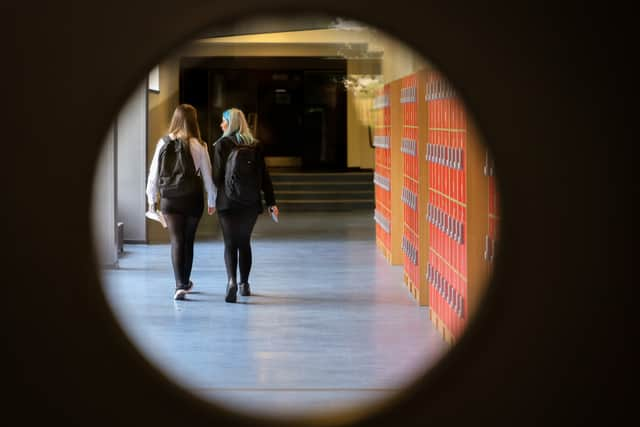
In 2024, the Scottish Government launched the Relationships and Behaviour in Schools Action Plan, aimed at addressing the challenges faced in schools.
A Scottish Government spokesperson said: “There is no place for violence in Scotland's schools. Our schools should be safe and consistent learning environments for staff and pupils alike.
"As previously stated, research shows that most pupils are well behaved. We have been working with partners including COSLA and teaching unions to implement the Relationships and Behaviour in Schools Action Plan to address the current challenges.
“Last year as part of this action plan we published new guidance for schools on consequences, developed in collaboration with headteachers, teaching unions and local authorities. The second annual progress report on delivery of the action plan shows that good progress is being made to deliver all twenty actions within the plan.
“As part of the plan, a working group is developing guidance to support improvements in the recording and monitoring of violent incidents across local authorities and schools.”
Councillor James Dalgleish, Education, Children and Families Convener said the City of Edinburgh Council is focused on “getting it right for Edinburgh’s children and staff”.
He said: “We have a zero-tolerance approach to abuse against teachers and support staff working in our schools, and any reports of these incidences are taken extremely seriously. We offer training to teachers and support staff working in our schools where required, to ensure that they are equipped to deal with any instances of behaviours of concern in an appropriate way.
“In addition to supporting staff when this does occur, we have extensive programmes to promote positive behaviour and to manage behaviours of concern in school, so we can try and reduce the number of incidents. Our focus is on getting it right for Edinburgh’s children and staff.”