
How India’s drinks market is hoping for a bigger place on Scottish menus as Tariffs reduced Post India-UK CETA
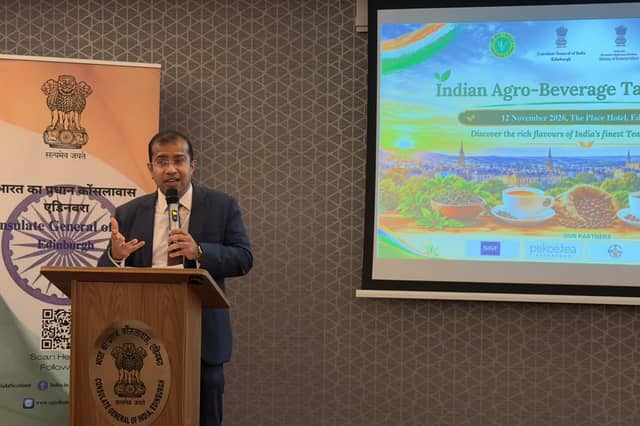

Scotland is being treated to a taste of Indian drinks, as the country seeks a bigger place for its beverages on Scottish menus. This is Partnership Content.
Indian tea, coffee and wine were on offer at a tasting in Edinburgh on 12th November, as the country sought a bigger place in Scotland’s shops, restaurants and hotels following the implementation of its Comprehensive Trade Agreement with the UK.
Organised by the Consulate General of India at The Place, York Place, the tasting was aimed at introducing India’s beverage sector to Scottish buyers and hospitality businesses.
The event came four months after the India–UK Comprehensive Economic and Trade Agreement, or CETA, came into force on 15 July 2026. Total trade between the two countries was worth £48 billion in 2025, according to the UK Department for Business and Trade. The agreement is likely to boost Scottish economy by £190 million.
Consul General Siddharth Malik said: “The India–UK CETA creates opportunities for businesses on both sides. We want Scottish buyers to discover the range and quality of Indian tea, coffee and wine, and to turn those introductions into lasting trading relationships.”
Tea and coffee are already part of the agreement’s early trading activity. In a joint statement following their October trade committee meeting in New Delhi, the two governments said both products were among consignments sent from India to the UK on the day the deal took effect.

Cutting the tariff on Scotch whisky to India
For Scottish exporters, a major change is India’s cut in the tariff on Scotch whisky from 150 per cent to 75 per cent, with further reductions scheduled to take it to 40 per cent over 10 years. The Edinburgh tasting focused on trade in the other direction, with Indian products seeking Scottish customers.
Dr Pete Cheema OBE, Chief Executive of the Scottish Grocers’ Federation (SGF): "Local retailers play a vital role in introducing customers to new and exciting products they may not otherwise encounter. For Indian suppliers, building strong partnerships with Scottish wholesalers and retailers, supported by reliable supply, competitive pricing and effective marketing, will be key to converting initial interest into sustainable sales growth.
The Scottish convenience sector is highly entrepreneurial and constantly looking for innovative products that can meet changing consumer demands. There is a significant opportunity for Indian companies to increase their presence in Scotland and across the UK through this route to market."
How tea linked Scotland and India
Tea has the deepest roots in that relationship. India’s growing regions offer distinct styles, from Assam’s rich, malty black teas to the lighter, aromatic teas of Darjeeling and fragrant Nilgiri teas from the hills of southern India.
At the tasting event, teas procured through the Tea Board of India included Darjeeling Tea, Assam Orthodox Tea, Assam CTC (Crush, Tear and Curl) Tea, Nilgiri Orthodox Tea, Masala Tea, Kangra Tea and Green Tea.
Scotland helped shape the nineteenth-century plantation trade. Robert Fortune, the Scottish botanist who trained at the Royal Botanic Garden Edinburgh, transferred Chinese tea plants to India for the East India Company.
Jon Cooper, Founder of PekoeTea Edinburgh, said: “Indian tea is remarkably varied. Assam, Darjeeling, Nilgiri and Kangra each offer a different expression of place and craft. Explaining those differences helps customers choose a tea they will enjoy and understand where it comes from.”
The connection remains visible in Scottish brands. Brodies’ Royal Scottish tea uses Assam tea, while its Scottish Morning coffee blend includes Indian Arabica.
India’s coffee industry is concentrated in the southern states of Karnataka, Kerala and Tamil Nadu. Its plantations produce both Arabica and Robusta, with coffee grown beneath a canopy of shade trees.
Indian beans give Scottish coffee blends a boost
The coffees at display were procured from the Coffee Board of India were Chikmagalur Arabica Coffee, Baba Budangiri Arabica Coffee, Coorg Arabica Coffee, Araku Valley Arabica Coffee and Monsooned Malabar Arabica Coffee.
Baba Budangiri’s place in Indian coffee history is linked to the tradition that Baba Budan planted seven coffee seeds there in the seventeenth century. Araku Valley, in the Eastern Ghats, adds a different growing region to the selection.
One distinctive speciality is Monsooned Malabar, made by exposing coffee beans to moisture-laden monsoon air on India’s west coast. The treatment changes the beans’ characteristics, giving roasters a product whose identity is tied to both its origin and its processing.
John Thompson, Owner and Consultant at Coffee Nexus, said: “India offers Scottish roasters a wide range of coffees to work with. Monsooned Malabar is a traditional, unique profile, while modern processing of Indian Arabica is giving a new generation of coffee drinkers a fresh look at an origin with a rich history. Growing interest in other species widens the range of roasting styles and flavours, appealing to diverse consumers.”
Opening the cork on Indian wine
Wine represents a more recent chapter in India’s international drinks trade. The modern industry includes vineyards around Nashik in Maharashtra around the famous western ghats and the Nandi Hills in Karnataka, while wines made from familiar grapes such as Sauvignon Blanc and Chenin Blanc offer an introduction to Indian production.
Fratelli’s estate at Akluj reflects a collaboration between Indian grape-growing and Italian winemaking. Grover Zampa has vineyards in both Nashik and the Nandi Hills, illustrating the geographical spread of the modern Indian wine industry.
The wines on display were Fratelli Classic Chenin Wine, Fratelli Classic Shiraz Wine, Fratelli Master Selection White Wine, Fratelli Master Selection Red and Rose Wines and Fratelli Sette Red Wine, alongside Grover Wine and Rhythm Wine.
Suryendu Satpathy, Managing Director of IndiMart Food and Beverages Limited, trading as IMDrinks, said: “Indian wines deserve to be considered on the quality of what is in the glass. Tastings help buyers become familiar with the styles, and give us a chance to discuss how those wines could fit Scottish restaurant lists and retail ranges.”
Wine tourism adds vineyard visits, cellar tastings and stays at estates such as Fratelli in Akluj, Maharashtra. For Scottish travellers familiar with whisky distillery tours, these experiences offer a similar connection between a drink’s character and the landscape and skills behind it.
For Scottish hotels and restaurants, the possibilities range from naming an Indian tea estate on an afternoon tea menu to offering an Indian coffee as a distinct origin, or adding an Indian wine to the list. Each would give customers a chance to explore the provenance behind the drink.
The tasting offered a starting point for new business between Indian producers and Scottish retailers, restaurants and hotels. With CETA supporting closer trade, there is scope to bring a wider range of Indian teas, coffees and wines to Scottish customers, while encouraging visitors to discover the gardens, estates and vineyards where they are produced.
Scottish hospitality businesses, drinks suppliers, importers and exporters interested in exploring opportunities can visit below website for further information, industry connections and potential commercial parternships: