
Inside Wouter Vrancken's Hearts 'bible' and 'worst enemy' as he sets out formation and tactical plans

Belgian head coach has a clear philosophy that he wants to bring to Tynecastle
New Hearts head coach Wouter Vrancken does not have much time to instil his philosophy into his new players. After all, there is a Champions League qualifier against Sturm Graz in little over a month’s time.
Vrancken takes the squad to Spain for a warm-weather training camp next week and will use that time wisely. It will be an opportunity to set out his principles and preach from what he calls his football “bible”.
The 47-year-old Belgian has carved out a reputation for well-coached, exciting teams in his homeland - most notably St Truiden last season after guiding them to a third-placed finish in the Jupiler League. He is keen to explain to Hearts fans what they will get from a Vrancken outfit.
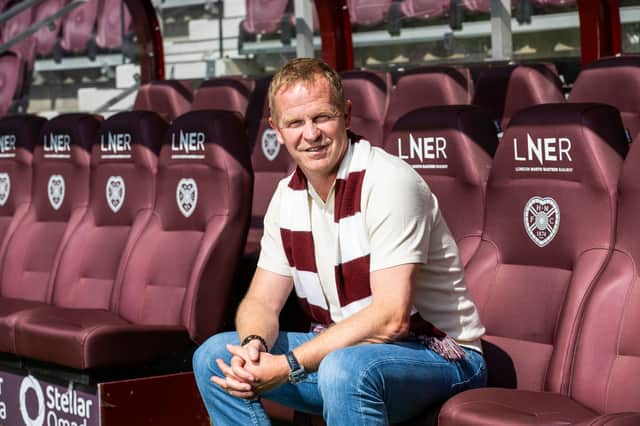

“I have a game model,” said Vrancken. “I worked on it myself, but it's like your own bible or something. Based on this, you're going to bring things to the players and explain what you want to see as clearly as possible. Because the thing I want the most is clarity.
“I always say to the players: not the opponent is your worst enemy, it's the doubts in your own head. That's the worst enemy. When you fully believe in what you're doing and every decision you're making on the pitch, you do it 100 per cent, then you've taken a big step. When you're doubting your own decisions, then it gets bad.
“There are a lot of principles, but what I would like to see is that I want the ball. Let's start with that. I want a constructive, positive way of playing and creating chances ourselves. We don't want the ball just to keep the ball; we want the ball to create something.
“I want to see joy. I want the players to enjoy themselves on the pitch, but to enjoy themselves within what they have to do for the team, of course. I think when you want to reach your full potential and show everything you have, you have to have that childlike joy - the reason why you started playing football at home or in the backyard.
“You have to bring that feeling onto the pitch to reach your full potential, and that's what we want to create: a lot of dynamics when we have the ball, a lot of runs, and trying to push the opponent into making decisions all the time. When you can do that as much as possible, you have a better chance of creating something.
“When we don't have the ball, transitions are also important. We like to play with high pressure, but within an organisation - not one by one, but in a structured way. That's it.”
The system Vrancken prefers to play
His tactical approach is likely to differ from his predecessor Derek McInnes. “When you look at it objectively, you would say 4-3-3 or 4-2-3-1 or something like that,” said Vrancken. “But for me, the formation is not the most important thing. It's more about the connections and dynamics between players. If one player does this, I have to do this.
“You have to find those connections. One player is running, another is taking the space the other creates. We have to build those connections to have a good build-up from the back. That's what the training sessions are for.
“Normally I will play with wingers. Sometimes they stay wide, sometimes they come inside, depending on the analysis of the opponent, the dynamics of the players and the qualities of the individual players.”
Vrancken has brought in two assistant coaches that he knows well in compatriots Tim Smolders, 45, and Cederique Tulleners, 35. “We have one really young one who has a lot of obsession, almost, and ambition for working with players and working on the pitch,” explained Vrancken. “Tim is a more experienced one already. He has also worked abroad. We played together with the Belgium under-21 national team, so I've known him for a long time.
“What I always like to do is divide the group of players into two, most of the time offensive players and defensive players, so that we can focus on them. Each assistant gets a focus group where they provide individual feedback and individual exercises. The other assistant works with the other group. I do as well, but a little more in general, picking out what I think is needed.
“Then we focus on making every individual better, because when we make every individual better, the team will also get better, for sure.”
Was there a temptation to have a Scottish assistant given Vrancken has never worked in this country before? “Yeah, for sure,” he said. “I wanted to have the mix, actually, and we still have the mix with the goalkeeper coach, the set-piece coach, the performance staff and the analyst. For me, it always has to be a mix because you have to know and feel the culture of the club, the city and the region all the time.
“That's why it's good that it's not Belgian and Scottish - it has to be one team. That's what I'm really open to in the staff. Maybe sometimes I'm too open, but I like proactivity. I like people who take responsibility.
“When you have responsibility and you know you're responsible for something, I think you're more engaged. You feel more with the team, and the emotions of winning or losing are even bigger than when you're just on the side. So I try to have everybody playing a part in it. I'm also just a small part of the total teamwork.”
Vrancken, whose only time in Edinburgh before now was a weekend break with friends two years ago, will now spend the coming days getting to know his squad better. “I met some players on Thursday because they came in for testing, so I didn't see them all,” added Vrancken. “On Friday I will see them all. Before, I watched a few games, including the last game, to get a feel for which players are already in the squad and to get to know them a little better than just through hearsay or names, so that I could see them for myself. I'm looking forward to that.”