
'I'm not really an academic guy' - Hibs gaffer with PhD in coaching brings 'off the cuff' approach to new gig
La Manga training trip provides Marink Reedijk with chance to stamp authority on squad
There’s an ugly sort of anti-intellectualism that pervades much of society these days. Whether you trace it back to politicians deciding that the public no longer needed “experts” to advise them on matters of proven fact, or pub bores droning on about “laptop managers” who have never played the game, those with proudly entrenched attitudes tend to be given the brightest spotlight and loudest megaphones.
Hibs will be braced, then, for a backlash to the very idea of appointing a 35-year-old Doctor of Philosophy (in coaching science, remember) to the post of manager. You could have set your watch for the first mention of Ian Cathro. And trust in the usual suspects to drum up predictions of confusion and doom.
Dr Voetbal never puts ‘theorising’ ahead of training-ground work
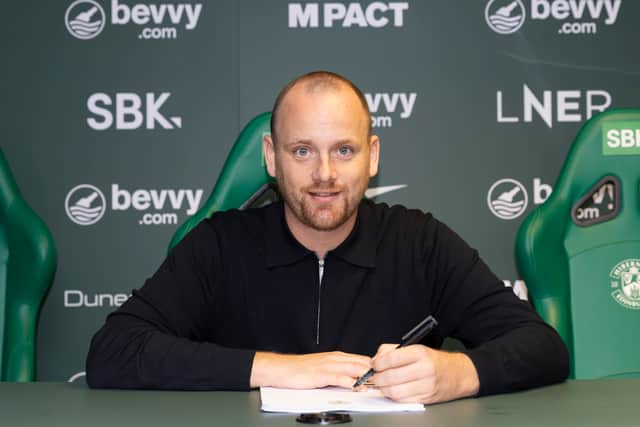

Because the people’s game remains susceptible to a misguided belief that it’s only for certain type of person. Not the sort who produce a 74-page doctoral thesis described as a “phenomenological examination of coaching.”
If you can get through the necessarily academic language, though, the entire basis of Reedijk’s work, needed to gain his PhD, can be boiled down to a couple of common sense ideas.
Don’t take anything for granted. And don’t think you know everything.
“I think I'm not really an academic guy,” insists Reedijk, the former SK Beveren boss adding: “It sounds strange if you have a doctorate, but I'm more of a practitioner who likes to be more educated - or broader educated.
“It was funny that I always had these conversations with the university, where they would say: ‘Yeah, but you are now also in academia.’ I was like: ‘No …’
“Where it helps me is that it brings me broader orientated ideas for practice, and I can structure and explain my thoughts in a much better manner because of the knowledge of the theory.
“However, I still feel - and am - the person I am, the coach I am, and this is more a practitioner who does things a little bit off the cuff instead of overthinking and theorising things.
“I know the theory is there, and it helps me also with understanding other aspects which are based on academia. So sports science, the medical department, I understand their point of view, where they come from.
“But at the same time, because of all the experiences I had before, in practice, I also understand where the practitioners and the top sports science comes from.”
Man management approach laid out
With just two seasons of professional, senior, first-team coaching experience under his belt, the former youth coach – who began working in the game while still studying for his Master’s Degree in coaching – will face some scepticism. Not least because he’s never managed a top-flight club.
But he’ll at least get time to work with his new team, thanks to the international break. He obviously intends to make the most of the warm-weather training camp beginning in La Manga on Saturday.
“For me, it starts with knowing the people who are behind the player, and then it is also important that you stay in communication with every player,” said Reedijk, outlining his approach to man management. “For me, every player counts.
“They come to the club, give a lot to the club as well. It's not often being seen, but players leave their countries or leave their hometowns, and the whole family moves with them.
“So for them they give a lot to the club as well, and therefore everybody should feel that they are part of a team and part of the club. That is the most important thing.
“Because at the end of the day we need everybody in the building, every quality of every individual, Bcause the season is long and the players will help each other to be better, and if the ones who play are challenged by the ones who don't play, that's the right atmosphere because then we challenge each other.
“Not only will the opponent challenge us, but we will challenge each other as well.”
Looking ahead to the week in Spain, Reedijk said: “It's a really good moment to make sure that I know the individuals and what people are there, not only the football players. I've seen that in the many matches I've watched, but it's also learning what kind of stories are behind the people.
“How do the people link with each other, and are the things you observe on videos really the things they are good at, or is there more in the locker? That for me is the most important starting point.
“And then from there what I believe is really important is to introduce the basics of what I believe in on the ball and off the ball and in the transition moments and the basic behaviour I want to see. That will allow them to understand me as a manager, what I expect of them, and how it will look like, and how the way of playing would feel and be experienced.”
The gap between theory and practice, from notepad to training pitch, is something every coach has to face. Just because you drew it up one way, that doesn’t meant it will work.
Hibs players will quickly find out just how much leeway there is in Reedijk’s “off the cuff” approach. And fans will judge the new gaffer – even our use of that term speaks to football’s factory-floor origins – on results.
There will always be those who believe that this game we all love is too complex to be understood by the educated outsider. That it defies any sort of scientific analysis, its secrets known only by ‘proper football men.’
With no game until October 10, when Hibs travel to Tannadice to take on Dundee United, those who subscribe to that narrow view will have plenty of opportunity to blast their opinions out at full volume. That doesn’t mean you have to listen to them.