
Hibs 'not chasing one golden goose' in their quest to do better financially

Barnett explains revenue plan and why it isn’t all fixed on one factor
Before Dan Barnett took up the position of chief executive at Hibs, costs were spiralling out of control. The accounts are the biggest indicator of that, with the latest set showing losses of nearly £6 million.
While that is an improvement on the previous year’s of just over £7m, there is clearly still a lot of work to be done to get Hibs on a sounder financial footing. Barnett, a quiet operator who arrived last August from Leicester City to take over from previous incumbent Ben Kensell, is striving to move the club in the right direction.
Hibs’ accounts in 12 months time should look healthier. They went on a good European run to the Conference League play-offs and raked in the guts of £6m for striker Kieron Bowie. His January move to Hellas Verona in Serie A became a record sale down Leith way.
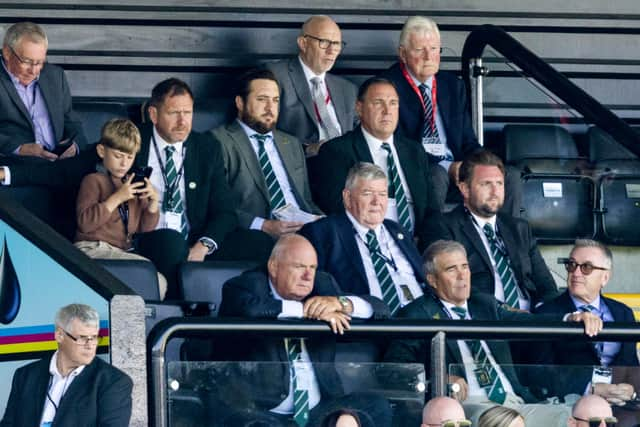

Hibs continue to have sellable assets at the club - midfielders Josh Mulligan and Miguel Chaiwa attracted interest during the last transfer window - but there is no pressing need to cash in on players. The ultimate ambition is to open up many revenue streams.
One of those is competing on the continent. Since the Gordon family assumed control of Hibs in 2018, they have made no secret of their desire to have Hibs playing in the main phase of UEFA tournaments. That so nearly came to fruition this season against Legia Warsaw. But despite the desire, the financial plan does not depend on it.
“European football, the group stages is worth a lot of money,” explained Barnett. “It's a substantial amount for the club. But even the qualifying stages, the various revenue streams, ticket gates, etc. the media rights is valuable to us. So that's why it's always a key goal for us. We want to be doing that year on year.
”You know, we don't necessarily budget for it. It is always our goal to finish in Europe. But if we do, those two strands that we're looking at, increasing the revenues and a robust player trading model, then it is not absolutely essential on any given year.”
The plan if Hibs don’t make Europe
Barnett was asked to explain how commercial growth can be achieved if Hibs don’t qualify for Europe. “There's a number of ways you can do it, actually,” he continued. “There's no one golden goose, but if you look at the various strands of your revenue streams, there's a lot you can do. I think bringing in retail in-house is an important and a huge step for the club. There's an opportunity there to substantially maximise our revenues. There's always more to look at in terms of partnerships and the way you build that to make sure you're maximising that.
“Linked to that is building your brand equity, effectively domestically, but also internationally. I think there is a story for Hibs. There's a magic of Hibs that I think is known domestically, but is not known as well internationally, particularly when we are in Edinburgh, the heart of the country, one of the most visited tourist destinations in Europe. We have our Irish roots as well, and I think that's a story that can be told better - more globally, in fact.
“Hospitality - I was pleased to see that that is selling out, but there's always more we can do. We have additional spaces that we're not using, Club 1875, and then also additional areas around the stadium itself, where we can do low-cost, high-fun areas for our fans to enjoy in and around the game.
“I think we need to make more of Easter Road, and we can do through hospitality options, but also third-party events, hosting games like the Scotland national team's Women's World Cup. There's a lot we can do there, and to be honest, I was pleased coming in to see that, because it gives us a growth trajectory.”
Barnett and his team, including the club’s finance director Philippa Lombardi, are moving in a “different direction” to before. At the Hibs annual general meeting last week, legacy contracts and previous commercial deals were noted. The club is going in a different direction now. “I have a methodology on how I like to do things and different people have different ones,” explained Barnett. “It didn't necessarily fit with what I was looking at.
“Look, I think when anyone comes in at a senior leadership position, they have their own vision on how they want to do things. And so I can't really talk to what happened prior to me. But it's safe to say that as an executive committee, we're all aligned that we might want to move in a different direction in some of those areas in order to maximise revenues, but also improve the supporter experience.
“There's been a lot of work done behind the scenes in terms of improving what we do commercially and operationally. So that means enhancing what we do well, but crucially also looking at our long-term legacy arrangements, agreements that no longer fit the club's needs and leave money on the table commercially. And so it's a mixture of exiting those and waiting for those to expire and then moving elsewhere. And then it's also creating new opportunities that fit with our vision and better serve the fans.”