
John McLellan's Festival Notebook: Mahler 5 Inside Out and Figaro

It’s not often you get the chance to sit among a world-renowned orchestra while the illustrious conductor deconstructs one of the world’s greatest symphonies. But to do so while lummoxing on a beanbag in a historic concert hall was an opportunity too good to miss.
And so last Friday I found myself lying between the Hallé Orchestra’s French horns and percussion section in the seatless stalls of the Usher Hall, as Sir Mark Elder explained his approach to Mahler’s Fifth Symphony which they would be performing the following night.

The famous Adagietto would be played faster than Leonard Bernstein’s seminal recording; it’s about love, not the funeral of a relationship, said Sir Mark, shortly after singing the melody in German.
As he explained the parts, singling out leader Roberto Ruisi and horn section leader Laurence Rogers for further conversation, it was like being on the set of Tär without the histrionics or sexual harassment.
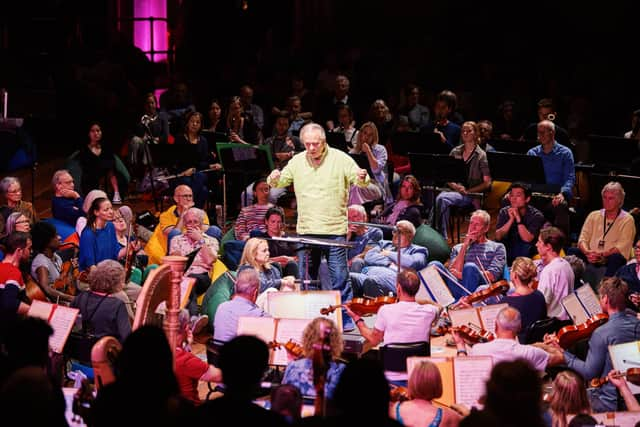
The Mahler 5 Inside Out concept is one of Festival director Nicola Benedetti’s innovations and what a success it proved to be, like sitting in the dressing room at training with Manchester City before seeing them play the next day.
There were the musicians in shorts and tee-shirts, and one percussionist in a kilt, and for me the intimacy created a connection with people with whom I barely spoke, apart from a few thank yous as we filed out together. The following night I looked out for them in their white tie and tails, as if confirmation was needed that they really were the same orchestra.
And what a treat it was to be so close as they demonstrated the complete precision of an outfit at the top of its game, with sections played to perfection with just a brief page reference and bar number from Sir Mark to let them know where each extract should start.
I played very bad drums in my youth, so it was a joy to be in with the percussion, not quite appreciated by the couple in front next to the bass drum, with their fingers rammed into their ears at each explosive passage. And there are a lot of them in Mahler 5. “Sorry about the noise,” said the percussionist afterwords. No need to apologise. None whatsoever.
The real thing the following night was an emotional close to Sir Mark’s 25-year leadership of the Hallé, with Prince Edward and Sophie, Duchess of Edinburgh, and Nicola Benedetti there to witness his valedictory, And, Sir Mark told us in his passionate address, so was legendary soprano Dame Janet Baker, now in her 90s, and by whom he had been inspired when he saw her perform in the Usher Hall nearly 60 years before.
Of the performance itself, tragic French composer Lili Boulanger’s setting of Psalm 130, with the Festival Chorus, was a spell-binding opener. But there was no overshadowing the thrill of a perfectly executed main event, particularly with the benefit of Sir Mark’s section-by-section analysis of the intricacies. A brief but wonderfully smooth Elgar encore and the curtain fell on his illustrious Hallé career and it was a privilege to be there. Proms or no Proms, why Radio 3 wasn’t there to record such a historic occasion was a mystery.
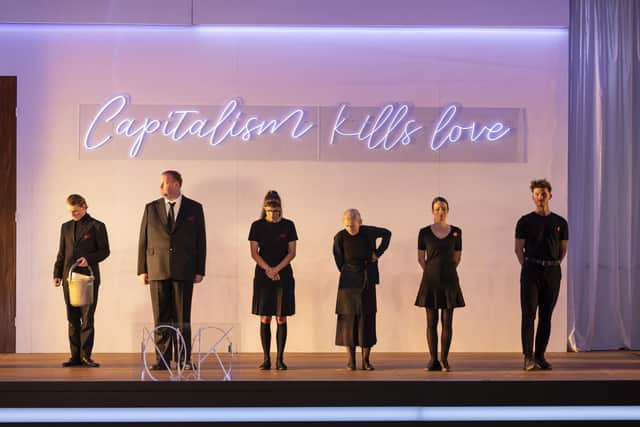
Somewhat less historic, but considerably more controversial was Friday night’s Komische Oper Berlin production of The Marriage of Figaro at the Festival Theatre, at times visually stunning but beautifully sung throughout.
Verity Wingate (Countess Almaviva) was particularly silky smooth, but Penny Sofroniadou (Susanna) and Karolina Gumos (Marcellina) were electrifying with their projection and presence, while Peter Kellner was a suitably energetic and powerfully mischievous Figaro.
With a brilliant orchestra conducted by James Gaffigan, it should have been five stars for Russian director Kirill Serebrennikov, but as most reviewers have agreed, the splendid performances were undermined by needlessly complex concepts and experiments.
With the stage split between an upper art gallery set and lower laundry/locker room affair, the action in one detracted from the performances in the other, and with audience attention darting between the two and the supertitles, business might have been brisk at Specsavers the next day.
But for me the low point was a dream sequence involving the mass stabbing of young women in the art gallery, complete with terrified screams. Ok, so the show was conceived some time ago, but with two victims of the Southport tragedy not laid to rest, this was far too much too soon for a UK audience. I’m no snowflake or censorship supporter, but as it was nothing to do with the Mozart original, no-one would have noticed if this sequence had been cut.
Like Mahler’s Adagietto, less is often more.