
Bonfire Night: Youth summit helped prevent fireworks mayhem of previous years
Edinburgh's police chief has told how insights from young people ahead of last year's Bonfire Night were key in preventing the mayhem of previous years.
But he warned against assuming the problem was over. "This is a multi-year problem that requires a multi-year solution," he said.
Chief Superintendent David Robertson, Police Scotland divisional commander in the Capital, was giving his quarterly report to the city council's culture and communities committee.
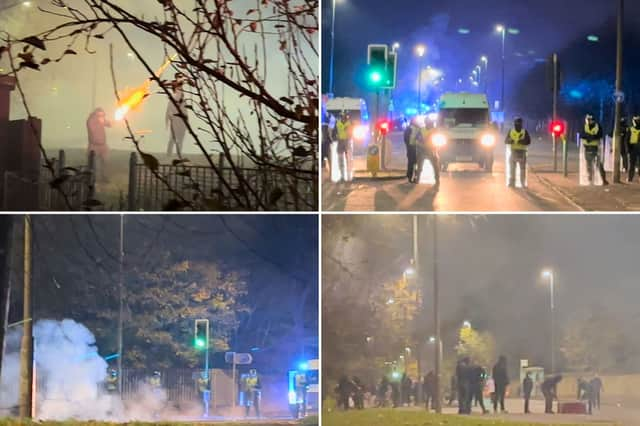

He said police preparations for Bonfire Night 2025 began immediately after the disorder of November 2024, when youths in balaclavas set off fireworks towards police, rocks were thrown at passing vehicles and buses came under attack.
And a youth summit at the Corn Exchange, called Igniting Change, had helped shape the police plans. He said it was "probably one of the most inspiring events I've ever been involved in".
Operations Superintendent Neil Wilson said analysis had identified "key drivers" for the disorder in previous years. "Principal amongst them was the use of social media by those involved to glamorise and normalise serious disorder and criminality and giving the impression that Bonfire Night should be viewed as an opportunity for consequence-free lawlessness.
"From experience, this narrative has particular resonance for young people and can negatively influence individuals who would not normally come into conflict with the law."
The youth summit, organised in co-operation with Fearless, the youth equivalent of Crimestoppers, saw 160 pupils from 19 of the city's 23 secondary schools come together to discuss issues around Bonfire Night.
Supt Wilson said: "The focus of the day was an opportunity for young people to share their views and reflections, enabling a tailored social media campaign to be delivered.
"A message that was received loud and clear was that we must communicate on platforms where young people are actually present - with Snapchat, Instagram and TikTok being the places where most traction can be gained."
Supt Wilson continued: "It was also abundantly clear that young people too were adversely impacted by the negative behaviours across the Bonfire season and we must not lose sight of the fact that it is a small minority of individuals who participate in such reckless and dangerous behaviour."
He said there was a poor understanding of the law around dispersal zones and firework control zones, designed to help tackle the problems associated with Bonfire Night.
Chief Supt Robertson said Edinburgh had been plagued by such problems for about 10 years, but last year’s efforts would offer a blueprint for the future.
"I think what it required was a redoubling of our efforts," he said. "For a long time, a small number of people and hard-working but potentially more junior staff across agencies were leading the response with limited decision-making power, limited resources.
"And I think what we needed to do as a city was take the issue much more seriously and see that level of leadership and direction and resources put into a multi-faceted response.
"I spent a long time thinking about and being asked about how do we crack this. I think in truth it's about a range of different issues coming together and it requires a range of different solutions. I think that's what we saw last year.
"I also think it's important to point out we shouldn't judge success on November 2025 alone. This is a mutli-year problem that requires a multi-year solution."
He said there was a commitment at senior level to "make sure we don't just stop because we had one good year".
"And I've spoken quite vocally about the need for us as a city to invest in youth work, to look at what we can do to support young people and look at young people as a solution to these issues and not being the problem."