
Edinburgh councillors rule out return of A-boards to city streets despite plea from businesses
‘When the A-board ban came in it was seen as world-leading’ - Cllr Chas Booth
A plea by businesses in Leith for an end to Edinburgh's ban on advertising A-boards has been rejected by councillors.
A petition from the Shore Business Collective asked the council to bring back A-boards "not as a free-for-all, but as a properly regulated, licensed form of advertising".
Ashley Harley, chair of the collective, told the city's transport and environment committee that lifting the ban would give struggling shops and restaurants a marketing lifeline.
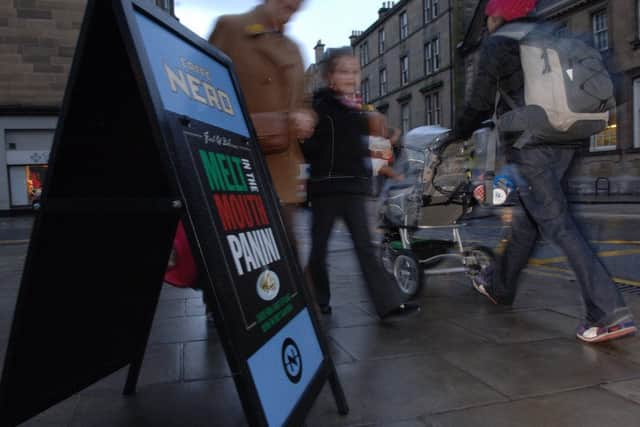

She said: "Edinburgh has had a city-wide ban on temporary, on-street advertising structures since November 2018. The council introduced this ban primarily on accessibility and street clutter grounds.
"We understand the reasoning. We're not asking the council to put accessibility at risk, we're asking whether the council can find a balance."
She said Transport Scotland guidance recognised that A-boards could be managed through appropriate controls. And she urged the council to move from a blanket ban to a controlled system.
Ms Harley suggested businesses could apply for annual licence and be allowed one board per premises, with strict conditions on maximum size, maximum distance from buildings or kerbs, with boards removed at night and so on.
She said one business owner had lost 10 per cent of revenue when the ban came in. "A-boards work. An A-board isn't simply a piece of street furniture - for a small business, it's often the most affordable form of marketing."
And she asked: "What is the difference between Edinburgh and Durham, Paris, Belfast, Glasgow, York, New York, Aberdeen, Rome - places where A-boards exist alongside visually impaired and less mobile pedestrians?"
Ms Harley argued that the right rules and sensible enforcement could allow the use of A-boards while protecting accessibility and safety on the streets.
And she said a fee of around £100 for an A-board licence would bring in extra revenue for the council.
She said: "Edinburgh currently charges businesses for occupying pavement space with tables and chairs, but it doesn't offer businesses the opportunity for a proper, licensed A-board."
The collective's petition also asked for a review of tables and chairs charging, which Ms Harley said was making it "unnecessarily difficult" for independent businesses to survive and thrive.
She said the charge for 100sq ft of pavement space in West Lothian was £268 per year, in Cardiff £650, in most of London a flat £500 per year, but in Edinburgh £1,570 outside the World Heritage Site or £1,979 within it.
Councillors agreed to look at the table and chairs charges, but voted to take "no further action" on the A-board ban.
Committee convener Stephen Jenkinson backed the ban, describing it as popular and successful.
Lib Dem transport spokesman Kevin Lang said he was “not convinced” about making any changes to the current policy. He said: “It is well established, well understood and I have real worries about unpicking it.”
But he noted the petition had almost 500 signatures and said a report from officials would allow a discussion in committee.
Tory councillor Jo Mowat said she was "very unconvinced" about bringing the A-boards back, but also argued for getting a report.
But Green councillor Chas Booth said the idea of a permit system had been considered when the ban was being introduced and rejected as not workable or effective.
He said: ”When the A-board ban came in it was widely welcomed by disability organisations and lots of other citizens. It was seen as world leading. We took the initiative to try and ensure that disabled people are listened to.”
The SNP’s Neil Gardiner also supported the ban, but pointed out that at election time. A-boards were allowed outside polling stations. And he said he would probably bring forward a motion to stop that. “If we are banning them in daily use, the same should apply to us as to retail outlets.”