
Edinburgh campaigners call for single traffic lanes on Princes Street to make way for cyclists
Wider pavements, new cycle lanes and one lane each way for public transport
Cycling campaigners are calling for Princes Street to be reduced to one lane of traffic in each direction to create enough space for wider walkways and the addition of cycle lanes.
And they say if that's not possible because of the volume of buses, the plans for the partial pedestrianisation of George Street should be amended to allow some buses to use that route instead.
That would mean both Princes Street and George Street would have wider footways, cycle lanes and public transport.
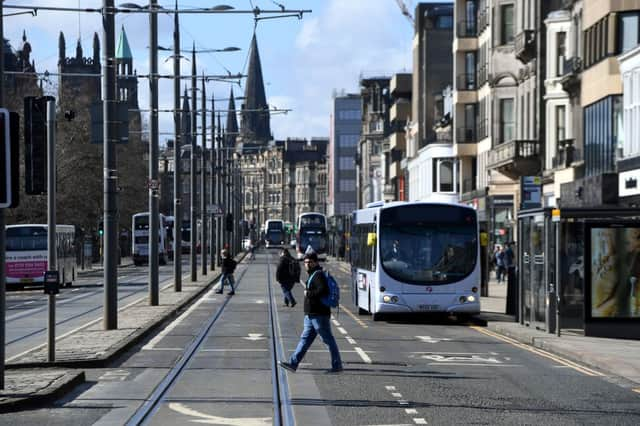

The proposals from Spokes come in response to council plans for the future of Princes Street to be discussed by the planning committee on Wednesday.
Previous plans drawn up by council officials were rejected by councillors last year as "too dull" and lacking in vision.
Spokes says the revised council plans are little different and do not live up to the recommendations made more than a decade ago by Danish architect Jan Gehl, brought in to revitalise the Capital's premier street, who described Princes Street as "a big bus station" and George Street as "a big car park".

Spokes says Gehl wanted to make Princes Street "a place with high pedestrian provision, safe cycling as well as quality public transport".
And Spokes added: "This can only be achieved by reducing the amount of road width allocated to bus, coach, tram and taxi, and possibly reducing their numbers."
But it said others argued the type of Princes Street envisaged by Gehl was undeliverable because "public transport could not cope without four traffic lanes".
The Spokes submission challenges that view, arguing that there is already only one lane in each direction both where Lothian Road joins Princes Street and at The Mound and that traffic could therefore cope with a single lane on the rest of the street.
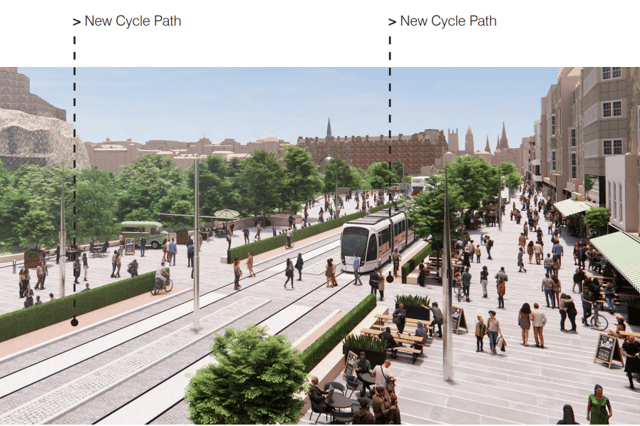
Spokes is more sympathetic to more radical plans put forward by Edinburgh architect Richard Murphy, which also envisage one traffic lane in each direction.
But the Spokes submission says: "If indeed a truly pedestrian and cycle-friendly Princes Street is not possible without reducing public transport levels - which we do not necessarily accept - then Spokes calls for a rethink on the relationship between the two streets, treating them in a more unified fashion, and reverting to the earlier George Street plans with wide footways, cycle lanes, and bus services.
"We recall historically that Gehl recommended a unified approach to Princes Street and George Street. Very regrettably, councillors subsequently decided this was too difficult and that the council would instead concentrate on George Street, leaving Princes Street to later decisions."
Spokes says it reluctantly supported proposals for George Street to become a "cycle street" on the basis of promises of "minimal motor access" but felt the plans had been repeatedly weakened to allow more vehicles in.
And the submission continues: "When George Street costs were rising significantly a few years ago, officers were asked by councillors if a low cost initial solution would be possible, removing central parking and private traffic, whilst installing cycle lanes and allowing bus and taxi use. Officers confirmed this was possible, in a relatively modest timescale and at relatively low cost.
"Spokes urges this initial approach, which would also at low cost test the feasibility of the wider unified approach to Princes Street and George Street.”
Spokes rejects the idea that cycle lanes on Princes Street are unnecessary because of George Street being a "cycle street". "Both streets [will be] either more suitable or less suitable for journeys with different origins, destinations and purposes. Indeed on some trips, diverting via George Street instead of Princes Street, and returning, would entail crossing tramlines twice, plus turns across major traffic flows."
And the submission concludes: “Both streets, in a European capital city like Edinburgh, should be places for walking, cycling and public transport, not seeking a supposedly gold-plated solution for one, whilst sacrificing the other.”