
Edinburgh's South Sub railway could reopen as extension of tram network
A plan to reopen Edinburgh's South Suburban railway as an expansion of the city's tram network will be presented at a public meeting next week.
The proposal - drawn up by a team of five civil engineering students working for their Masters degree at Edinburgh's Heriot-Watt University - involves running "tram-trains" on the 12.3km route and connecting the line into the city's tram system.
And city transport convener Stephen Jenkinson wants to include the plan the city council's business case to secure funding to extend the tram network.

Corey Boyle, one of the team, says their study shows that one of the biggest stumbling blocks to reopening the line can be solved by avoiding the bottleneck around the city’s two busiest stations.
He said: "Four previous feasibility studies have seen the potential of reopening the South Sub, but they have been unable to overcome the critical capacity issues at Haymarket and Waverley, whereas with our new study we have shown that that is surmountable by connecting to the Edinburgh tram network at Murrayfield, bypassing both Haymarket and Waverley.
“We propose reopening the South Suburban Railway to passenger services as an extension of the Edinburgh Tram network using tram-trains.
“Tram-trains are light rail vehicles that can operate on both tram tracks and mainline railways, enabling direct journeys between city centres and suburban areas without transfers. They have been successfully used in Europe since 1992, particularly in Germany, were introduced in Sheffield in 2018, and will begin operating in Cardiff in 2025 as part of the South Wales Metro.
“Our work is the first proper study on reopening the South Sub since 2008 and the first since Edinburgh Trams opened in 2014, making it the first to seriously consider tram-trains.”
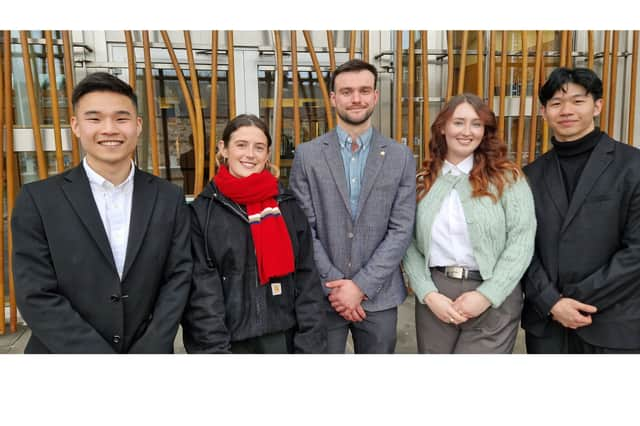
Corey said the proposal drawn up by the team - Chang Xun Tan, Natalia Greenan, Corey, Caitlin Cummings and Yuen Fong Hoo - would be “significantly more cost-effective” than both the original tram project and the extension to Newhaven since much of the necessary rail infrastructure was already there. The main construction required would be the Murrayfield connection to the tramline and reinstating old stations and adding new ones.
And he says there is strong public support for the project. "We’ve conducted two public surveys, both of which have been overwhelmingly supportive. We’ve also attended community council meetings along the South Sub with the public also being overwhelmingly supportive.
“They know the infrastructure is in place and they’ve heard of past so they want to see it reopened. We believe we have provided sufficient evidence for Edinburgh Council to commission a new feasibility study into reopening the South Sub to passengers using tram-train .”
The South Sub opened in 1884 and had seven stations along the route, but closed to passengers in 1962 as part of the notorious Beeching cuts which axed a huge swathe of local rail lines across the UK.
Today it is used for freight and occasionally as a diversion route, but there is still plenty capacity which would allow the tram-trains to run in addition to the freight trains.
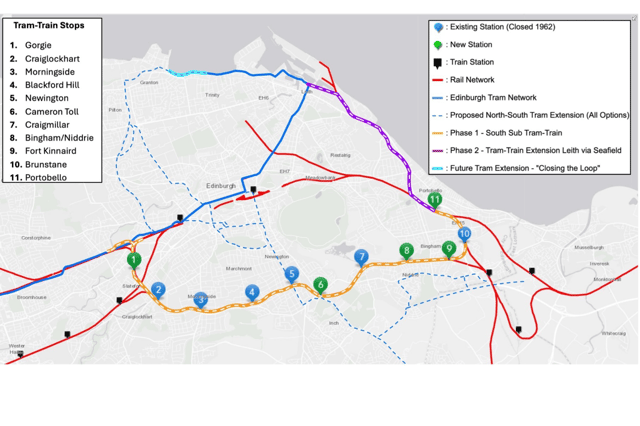
The team’s proposal is for four tram-trains per hour in each direction, with 11 stations along the route - five existing ones at Craiglockhart, Morningside, Blackford Hill, Newington and Craigmillar; and five new ones at Gorgie, Cameron Toll, Bingham/Niddrie, Fort Kinnaird and Portobello; plus Brunstane, which is on the Borders rail line.
The main link to the tram network would be at Murrayfield - and this would be where the biggest engineering part of the project is needed.
The line would go under the Roseburn bridge, which carries the main Edinburgh-Glasgow railway, then split in two, the left going to the Balgreen tram stop for passengers heading towards the airport, and the right going to the Murrayfield stadium and towards the city centre. There would the option of another stop at Westfield Road, which could help cope with large numbers attending evets at Murrayfield.

There would be a direct connection at Cameron Toll with the proposed new North-South tram extension, allowing passengers on the South Sub line to access the Royal Infirmary and the BioQuarter, and giving North-South passengers a link to Portobello.
Portobello would be the terminus of the South Sub line. To avoid the busy East Coast mainline, the route would go up an embankment after leaving Brunstane station and onto Sir Harry Lauder Road, where it would continue on-street until the Portobello stop.
The the team has costed the plans at between £113m and £167m - which works out at between £9m and £13.5m per kilometre, compared with the original tram project’s cost of £55m per km and the Newhaven extension’s cost at £44m per km.
A second phase of the project could take the route on from Portobello to Leith via Seafield, using five kilometres of the Leith branch line.
The team gave a presentation on their plans to Edinburgh MSPs and councillors at the Scottish Parliament.
Transport convener Stepen Jenkinson said a public consultation on the proposed North-South tram extension from Granton to the Royal Infirmary and BioQuarter was due later this year, the results of which would help shape a strategic business case which the council would present to the Scottish Government.
He said: “I have asked officers to look at the South Suburban railway as an opportunity to complement that strategic business case, to strengthen it, so that when we go to the Scottish Government to help fund these big projects we will have a stronger business case to back up the delivery of the project.
“How you phase the project, which bits you deliver in which order, will be a decision the council will take once we know what the funding situation is. But at the moment, I'm of the opinion that we have an asset on the ground, we have the possibility of using it going forward and we should leverage that to strengthen the business case for the North-South tram if we can.”
Edinburgh Southern Labour MSP Daniel Johnson said: “The South Sub Tram Train could transform journey times east to west across the city, linking the BioQuarter and Seafield with Haymarket and Edinburgh Park.
“By repurposing existing lines and using hybrid trams, this post-graduate student project shows what the possibilities are.
“Now that we know the infrastructure and technology requirements, we need a full feasibility study which is why I have written to Scottish Ministers, the Council, and Network Rail calling on them to do this.”
The plan will be presented at a public meeting on Monday, March 17, at 6.30pm in the Waiting Room pub at 7 Belhaven Terrace, Morningside. It is free but ticketed via Eventrbite.