
Margaret's hoping for a Xmas free from the fear of arrest - Bruce Whitehead
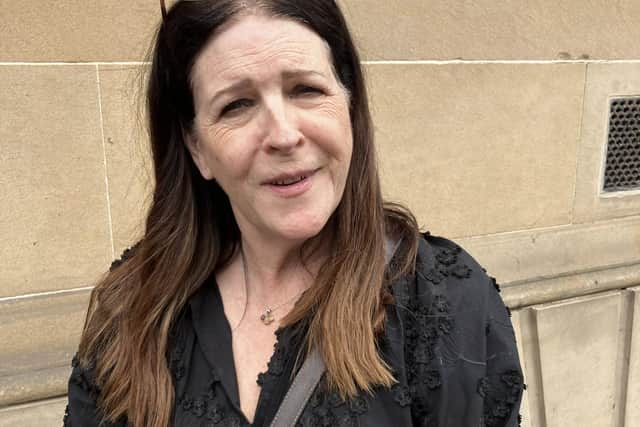
Last Christmas Margaret McLaughlan, a 67-year-old retired English teacher, was putting up decorations in her Glasgow family home. Suddenly the doorbell rang and two anti-terrorist police in combat gear burst in to arrest her under Section 13 of the 2000 Terrorism Act.
They said she had shown support for a proscribed terrorist organisation, Palestine Action, outlawed in June 2025 by Home Secretary Yvette Cooper after it admitted £7m of damage to RAF warplanes.

Unable to sabotage Israeli warplanes, the activists resorted to daubing red paint on ours, hoping their message would get across (the RAF Akrotiri base in Greek-held Cyprus has been accused of assisting Israeli surveillance of Gaza).
It's fair to say that it has got across - aided by Yvette Cooper's bizarre banning of a group whose entire ethos is opposition to violence and terror. Even King Charles's former adviser, Friends of the Earth honcho Sir Jonathon Porritt, got the message, arrested with 500 others in London last year.
However, one rogue Palestine Action activist almost fractured a policewoman's back in 2024 while vandalising lethal Israeli drones made by British Elbit workers, seriously undermining the peaceful ethos of the vast majority of PA supporters.
One such supporter is Margaret McLaughlan, who joined an Edinburgh protest last year at Middle Meadow Walk, with a placard reading: "I oppose genocide. I support Palestine Action".
The media describe such people as "pro-Palestinian"; while many describe themselves that way, mostly they're just opposed to bombing innocent civilians.
Most don't support militants but are pro-Palestinian rights. Many aren't "anti-Israel" but they're opposed to Israeli governments inflicting what the UN has called genocide on neighbouring countries – 1200 Gazans have been slaughtered since Israel supposedly agreed to stop.
Margaret knew she might face further police attention if Palestine Action's appeal against its banning was rejected. But before the UK High Court threw out the ban in February, heavily armed officers had arrested her twice.
I met her, mild mannered and clearly spoken, on Tuesday at Sheriff John Cook's court in Chambers Street, where he continued the case against her, along with 52 co-activists.
The Sheriff apologised for the "terrible" acoustics caused by two anti-spitting screens; the mumble of the clerks briefly rose to a bawl, but tailed off again, so that many defendants weren't sure if they'd been processed.
Then a police officer spotted one of the offending slogans under a jacket, and ordered another arrest, adding yet more pressure on the creaking justice system.
Perhaps Sheriff Cook hopes the Supreme Court will give him a steer on what to do with all these retired teachers, mums and dads, nurses and lecturers on his books. After all, it was the UK government who urged Scottish police to arrest them for peacefully opposing the carpet bombing of civilians.
Another person I met was a warm, smiley former midwifery nurse hoping the government might come to its senses and un-ban Palestine Action, freeing the protesters to return to their allotments and rambling clubs.
She described the sunny Meadows event, with a choir singing peace songs under the trees and told me that her professional code of conduct requires that she "alleviate suffering".
Voluntarily attending St Leonards police station to be fingerprinted, she had the sense that police saw the lunacy of arresting pensioners for opposing a modern blitzkrieg that uses partly Scottish-made weapons.
Protesters had good reason to hope their case would be thrown out. I was shown a copy of an advisory note obtained by their legal team, from UK Anti-Terror Police, operating on the instructions of the Crown Prosecution Service (CPS), to Police Scotland.
It reads: "Example of a sign that CPS England and Wales would be unlikely (in red type) to charge for under Section 13 of the Terrorism Act."
"GENOCIDE IN PALESTINE...TIME TO TAKE ACTION" reads the sign, like the Meadows ones carried by the 52 accused.
The advice continues:
"The sign contains two statements [referring] to 'Palestine' the country and "Action" the verb. For this reason the CPS have taken the view that this particular sign does NOT arouse suspicion that the displayer is a member of a proscribed organisation." (Actually, "Action" is a noun..)
If the advice is genuine - the government hasn't disputed it - then the case should be thrown out so that Margaret McLaughlan can put up her Christmas decorations without fear of traumatic arrest by Scottish terror police acting on UK government instructions.
Last week a jury in leafy Kingston-on-Thames threw out another daft case, against a Jewish critic of Israeli and British government policy, Tony Greenstein, for allegedly supporting terror. Following Hamas' 7 October attacks on Israel, Greenstein had suggested online that Palestine had the right to resist occupation, but was acquitted of supporting them.
Edinburgh journalist and former ambassador Craig Murray has launched a judicial review of the PA ban, accusing the government of lying, but judges have repeatedly suspended the case. Murray says juries are the only hope for justice; perhaps ministers are simply hoping it will all go away.