
How that first Christmas Day derby - exactly 150 years ago - sparked Hibs-Hearts rivalry still going strong
Historian Mike Hennessy brings to life the game where it - probably - all began for one of football’s great love-hate relationships
A century and a half on, many of the details remain shrouded in mystery. And there’s always a degree of doubt when it comes to the exact order of events.
But the one thing historians seem to agree on is that, exactly 150 years ago to the day, a new football club by the name of Hibernian FC took on Heart of Midlothian – still pretty fresh themselves – in a game described by one expert as an act of friendship. And so began, we believe, one of the great rivalries in football.
Frank Boyle’s famous cartoon reimagines the scene
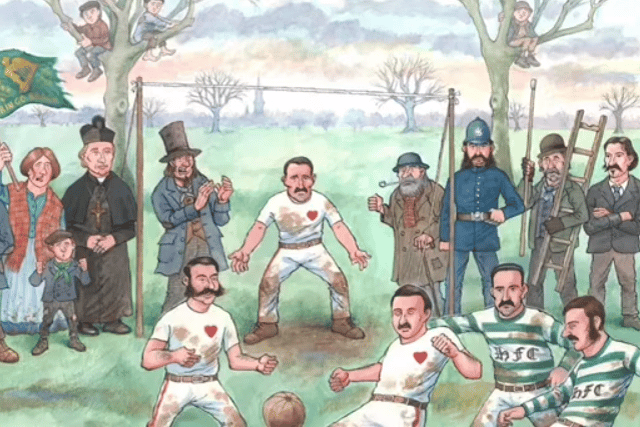

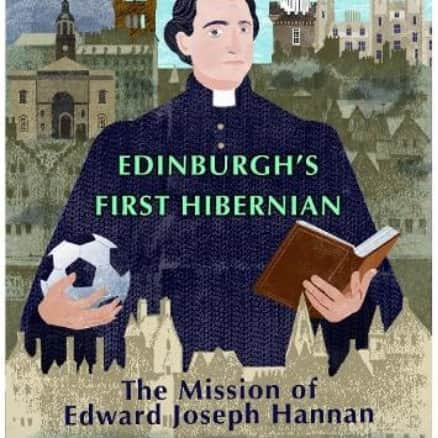
According to Mike Hennessy, whose book Edinburgh’s First Hibernian shed new light on the founding of Hibs, the very second public mention of the club – months after their foundation – comes from a six-line match report in The Scotsman on December 27. Interestingly, only four names from the Christmas Day 1-0 win for Hearts are recorded for posterity, Cavanaugh and Byrne for Hibs, plus Wylie and Laidlaw for the Jambos.
Hennessy, who has produced the following report for The Evening News with help from HMFC historian Dave Allan, writes: “A famous cartoon by Frank Boyle commemorates the occasion. There are a few details worth mentioning.
“First, the spectators. The priest Father Hannan, Irish navvies and a woman with an Irish flag stand together with some interested Edinburgh bystanders, a police constable, a lamplighter and author Robert Louis Stevenson. Then the strips.
“Whilst the Hearts one could be correct – there is an 1875 photo of the team in white shirts with a heart sewn on the left breast, and it is thought that they didn’t adopt the red/white/blue colours and then maroon till 1876 – the Hibs one is questionable. The Hibs first rules published only a few months earlier said their uniform would be white Guernsey (knitted) with a harp on the left breast, so it is unlikely that they would have adopted the hoops within months.
“Those probably came at the start of the 1876-77 season, perhaps as Hibs joined the EFA and SFA, and there are a couple of photos in existence of the team in hoops dating from1876 and 1879. But both teams couldn’t have played in white on Xmas day, could they?
“Another possibility is that Hearts played in a hooped red, white and blue strip (with “HMFC” across the chest in exactly the same place where “HFC” is shown on the Hibs strip in the cartoon). There is another early Hearts team photo showing them wearing such a strip, though obviously one can’t determine the colours.
“This strip was worn by the original Hearts before they merged with St Andrews in late 1876. Hearts bought their early kits from Percival King’s workshop in Lothian St, and it would be no surprise if Hibs had done the same, copying the Hearts hooped design before they joined the EFA.”
Christmas Day not a holiday in ‘Presbyterian’ Edinburgh circa 1875
Questions of kit clash aside, there was another potential stumbling block to this first ever Edinburgh Derby – as we now know it – taking place, Hennessy explaining: “Christmas Day was not a holiday in Presbyterian Scotland. In 1875, it happened to fall on a Saturday, hence the game was played that day.
“But the Catholic Hibs players would have been expected to attend midnight mass the evening before, giving them a perfect excuse for losing next day, despite playing against eight men for the first 20 minutes. As temperance was a condition of CYMS membership, they did not have the excuse of a hangover!
“That the game in question was the first has also been challenged. What were Hibs doing between their formation in August 1875 and the Xmas day game? Presumably playing friendlies since they were not in any cup competition.
“But against whom? There were very few Association code teams and the EFA/SFA discouraged their members from playing Hibs.”
Hearts broke with anti-Hibs factions to play friendly
Hearts were the first club to break with the anti-Hibs factions, volunteering to play Hibs on Christmas day as – to quote Hennessy’s studied interpretation of the evidence – “an act of friendship.” Laying the groundwork for a rivalry that has rarely been anything short of febrile in the century-and-a-half since.
By September 1876, despite the efforts of a notoriously anti-Catholic lawyer trying to rally clubs against Hibs, the Edinburgh club were accepted by the EFA. And then the SFA.
Hennessy adds: “Hibs Historical Trust is currently putting together thumbnail sketches for each of the early players and officials. Early work using the 1881 census suggests that the players were not unemployed Irish peasants as some have been keen to paint them, but working or lower middle class young men, mostly employed in local industry or crafts. And hardly undernourished since you had to be able to run around a football pitch for more than an hour.”
The rest, as they say, is history. And geography, once you factor in a few ground moves. Plus the obligatory politics, including Hearts losing their EFA membership – and Hibs helping their nearest and dearest back into organised football with friendly games in 1877.
Not that it was all played out in a spirit of camaraderie and bonhomie, Hennessy noting: “In a further sign of deteriorating relationships, in 1880, Hearts attempted to have Hibs expelled from the EFA for the rough play of their players and their fans’ aggressive behaviour. Their attempt failed, but only due to the casting vote of the chairman.”
Hostilities resume at Easter Road on Saturday. Maintaining a festive tradition that all started (we’re pretty sure) on Christmas Day all those years ago.
Huge thanks to Frank Boyle for his wonderful artwork, more of which can be found here: frankboyleart.bigcartel.com