
Exclusive:Hibs origin story revisited as historian addresses Irish roots, Scottish heart and 'just another Sevco' banter
Expert breaks down early attempts to exclude ‘foreign’ club
Hibs fans may have to revise their understanding of the club’s origin story after new research revealed some fascinating twists in the foundation of the Edinburgh team. And Hibee-supporting historian Mike Hennessy insists he can put a definitive end to “banter” about the proud sporting institution being “another Sevco” who went bust just as they were getting established.
Hennessy also believes that Hibs, initially denied a place in the game because of their ‘foreign’ roots, were as much a Scottish as Irish club even during those early years. The lifelong fan, who can count Irish President Michael D. Higgins and current Hibs chairman Ian Gordon among fans of his new book, tells a fascinating story perfectly timed to coincide with the club’s 150th anniversary season.
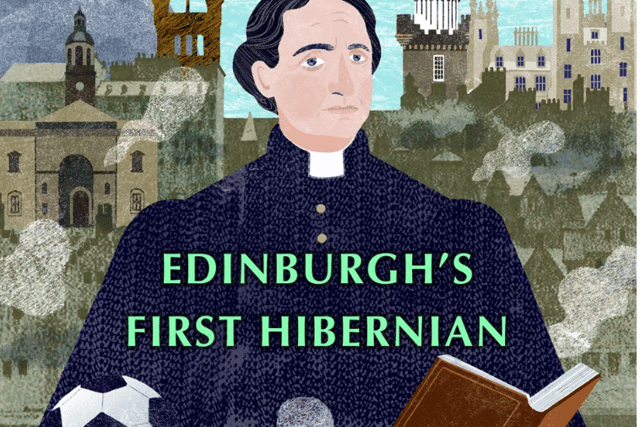
In Edinburgh’s First Hibernian, The Mission of Edward Joseph Hannan, a hefty piece of academic work that reads as much like a social history of Edinburgh in the late 1800s, Hennessy addresses many of the popular narratives that have grown up around Hibs. But his main focus is on Hannan, a priest from Ballingarry whose own history definitely deserves a wider airing.
“We discovered nobody knew anything about the man himself,” said Hennessy, explaining how he and a handful of friends had begun digging into the subject. “There are revisionist historians, including Hibs revisionist historians, who claim that Hannan wasn't involved in the club till 1877. And so there's a piece of the book which proves that this is absolute nonsense.
“I put together a lot of circumstantial evidence about how Hannan must have been involved with the club in the early days and even probably named it, although Michael Whelahan gets the credit. Hannan probably named it, knowing Hibernian is Latin for Irish and all that.”
Hennessy, who insists his work is a biography of one man as much as it covers the story of Hibs, is fascinated by the identity politics surrounding a club he began supporting back in the 1950s. His great-great grandfather was a parishioner of Hannan – and his grandfather was the person who started taking him to Easter Road.
Diving into the delicate subjects of nationality, religion and integration, he explained: “Hibs over the years have struggled with this, but Hibs are portrayed as an Irish club originally. And there's no denying your roots. But I went into some detail as to what those roots were.
“And Hibs fans will be quite surprised when I claim that this was as much a Scottish club as it was an Irish club. The evidence for that comes from the 1881 census.
“There was a list of about 60 people involved with the club, players and officials and all the rest of it. And half of the players were born in Edinburgh, albeit to Irish parents, perhaps. And many of the officials as well.
“And suddenly you've got this bit of mix that, OK, the parents were the Irish influence, and maybe half of the generation that played for Hibs were. But half of these guys were Scottish.
Easter Road club now a major force in Scottish game
“Which makes it all the more curious that when the Edinburgh FA and the SFA were considering letting Hibs join or not, they came out and said: ‘This association's for Scotchmen and not Irishmen.’
“I don't know why Hannan didn't push back and say: ‘Well, here's the evidence, mate. All these guys were born in Edinburgh.’ But he didn't, for whatever reason. So, you know, if Hibs wanted to tell a story about the blend of Scottish and Irish and coming together and the best of both, etc, they could.”
Why were Hibs shut out of Scottish football?
Revealing more about the motives of the authorities in denying Hibs a place in organised football, Hennessy pointed out: “The SFA was newly formed. I mean, this game only started really in Scotland with Queen's Park in, what was it, 1867? Rangers were 1872. Hearts were 74, possibly 75. No one really knows. So it was all very new.
“As today, much of the power base was in the west of Scotland. These were the moving forces in the game.
“And we don't quite know why they said no. But they SFA pushed it back and said the Edinburgh Association needs to take a decision. The Edinburgh Association was only made up of four clubs, one of which was the Third Edinburgh Rifle Volunteers.

“And it's circumstantial evidence, but I've checked it with the SFA Museum and people, the Third ERV was run by a guy called John Hope, who was a massive anti-Catholic lawyer. Hope had clashed with Hannan on many occasions outside the footballing sphere.
“And I'm pretty convinced that Hope had a veto on this initially, but the other three eventually said: ‘This is stupid. We're going to vote you down three to one, so we might as well admit Hibs.’
“Now, I can't prove that, but I've put together what I would call circumstantial evidence to support the argument. And that's something that fans will find interesting.
“There was still a big anti-Catholic feeling in the hometown of John Knox. I mean, you can't get away from that. Despite some very enlightened people, including the Lord Provost, who understood the need to integrate these immigrants, and to make them honest citizens, and contributors to the economy, rather than people who just took … and that's where the social piece comes in.
“The Catholic Young Men's Society had its honorary members. And 13 of them out of 20-something were Protestants who saw the benefit in supporting an organisation for these immigrants.
“So it wasn't as black and white as it can be painted. People understood the fabric of the city needed the integration of the immigrants.”
A century and a half on from that famous meeting in the Cowgate, the fact that so many Hibs fans remain interested in finding out more about the foundation story of their club comes as no surprise to Hennessy, who said: “People are interested in their roots, whether it's their family roots or their football roots or whatever. In my case it's the same, because my great-great-grandfather was Hannan's parishioner.
“So I've got a very personal stake in all of this. But the success of the book so far, and we're selling well, especially to Hibs fans, just says that, well, fans in general want to know where their club came from.
“And there’s a bit of the social media argument, people winding up Hibs fans and saying: ‘Ah, you’re just another Sevco because you went out of business back in 1891 …’ A lot of Hibs fans really want to disprove that. And I can, by the way. So you can make it go away.
“But I think the banter, maybe in a local context, in a Scottish context, the banter probably gets people interested in their history. And it’s quite a history, with Hannan at the heart of it. As one of the reviews put it, I’ve taken a guy who was always in the background and moved him to the foreground.”
Edinburgh’s First Hibernian, The Mission of Edward Joseph Hannan, is published now. See https://www.thirstybooks.com/bookshop for more.