
Edinburgh's George Street revamp: 'Bring in interim changes as soon as possible' say cycling campaigners
Low-cost changes should be made to Edinburgh's George Street as soon as possible, cycling campaigners have said following the council decision to halt plans to fund a full revamp of the street from the city's new tourist tax.
The £32 million revamp was due to see George Street become a "cycle street" and pedestrian priority zone, with parking down the centre of the street removed and vehicles banned for most of the day. The scheme also included new paving, planters, trees, benches and security measures.
But when the proposal to use Visitor Levy money to borrow the necessary funding was considered by councillors last month, they agreed to delay the plan and look at a wider city-centre scheme which would include Princes Street.
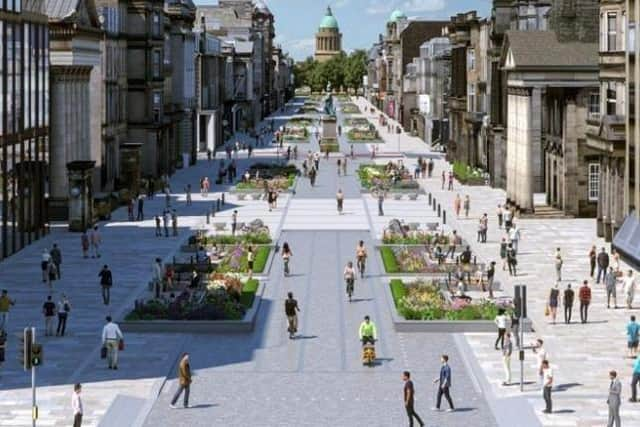

Cycling campaign group Spokes has now written to transport and environment convener Stephen Jenkinson, arguing for early improvements to the street, "even if they are only interim solutions for a number of years".
Spokes set out two options. It said its "strong preference" would be for removal of the central parking, the reduction of traffic lanes from four to two, with wider footways and uni-directional, kerb-protected cycle lanes on both sides.
"This type of approach was in fact accepted to be a feasible low-cost option by transport officers a few years ago, when concern was growing about escalating project costs, but was rejected in favour of developing the more comprehensive, but costly, current scheme.
"It also has the advantage of preserving symmetry, important from a heritage perspective. Under an initial, low cost, scheme, the central setts etc could be retained and the space repurposed, for example seating and planters with trees.
"The proposal would ideally also be accompanied by restrictions on moving traffic, for example allowing only taxis, buses and necessary deliveries, although this could be a later stage so as to aid early implementation. The removal of central area parking would in any case substantially reduce private motor traffic."
The other alternative it outlined would retain the central parking but remove all traffic from one side of George Street, enabling a wider footway and two-way bike lane. Spokes said it would be easy to implement and had been tried before.
"The council actually did this as an 18-month experiment in 2014-2015. The scheme was a considerable success, with increased footfall, reduction in cars, and people feeling it made the street more pleasant and encouraged them to return."
On the longer-term plans, Spokes said it had always been concerned that there should be safe and attractive conditions for cycling on both George Street and Princes Street.
“Both streets are important destinations in their own right, and both serve essential, but different, functions for through-journeys.”
George Street was an essential “missing link” in the City Centre West to East Link (CCWEL) cycling route which had otherwise been completed.
But it continued: “Princes Street is also a vital through route for many journeys. Whilst some in the council have suggested that George Street is a suitable alternative for all cycling trips, this is far from the case. Indeed, for some journeys, to use George Street rather than Princes Street would entail not just a detour, but crossing tramlines twice and/or undertaking additional main-road left and right hand turns. Visually it appears that as many or perhaps more cyclists use Princes Street than George Street, despite the tramline s.”
Councillor Jenkinson said the council had to reflect and take stock of the situation following the council decision. He said: “In light of the decision of full council, we need to assess where we are with regard to the delivery of projects in the city centre, which will take some time.”