
Mystery deepens over bizarre animal bones discovered in wake of Arthur’s Seat wildfire

Analysts discovered the bones had been gathered from a variety of places and deposited on the hill at different points in time
The mystery of hundreds of animal bones exposed after a wildfire tore across Arthur’s Seat last August remains unsolved, after archaeologists said analysis of the rare discovery had raised “more questions than answers”.
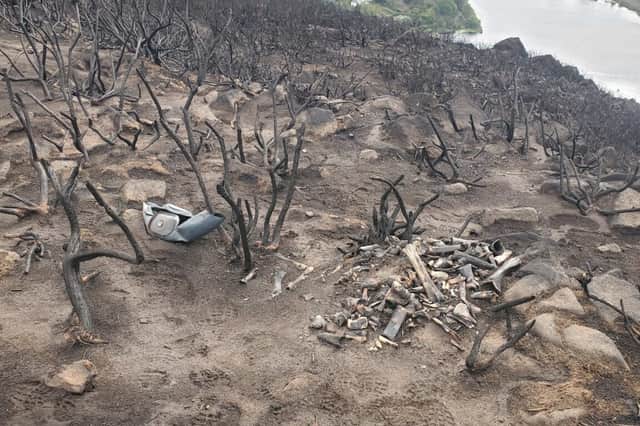
The thirteen-kilogram pile was discovered by park rangers close to the remains of a prehistoric hillfort on Crow Hill, which lies to the east of Arthur’s Seat, while carrying out a routine patrol of the hill in the aftermath of the fires.
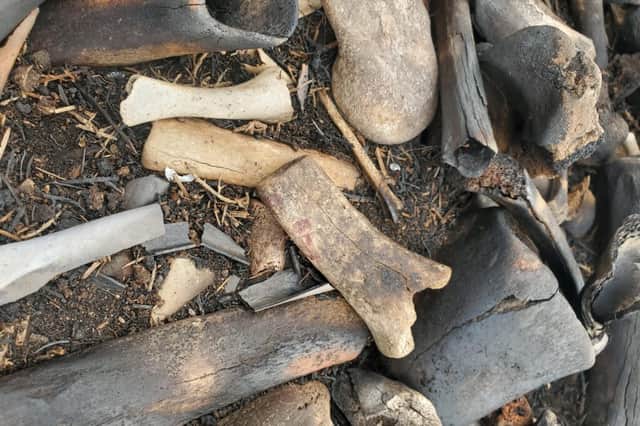

The bones were found visible on the hill’s surface, but had likely been hidden from view by vegetation until the fire exposed them. At the time, Historic Environment Scotland (HES) described the bones as an “unusual” and “potentially significant” discovery.
But a year on, after extensive analysis by archaeologists, the results have left experts baffled.
Evidence suggests the fragments were sourced from a variety of places and deposited on the hillside over time, deepening the mystery of how, why and by whom the peculiar assortment was created.
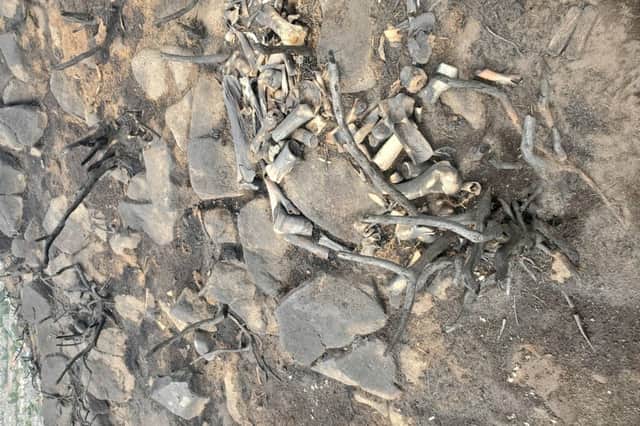
Bones sourced ‘from all over’ and deposited ‘over an extended time’
Analysis by AOC Archaeology revealed the assortment contained more than 800 fragments of bone - over 300 of which were categorised as “unidentified mammal long bones”.
Others were found to have derived from cattle, horse, pig, sheep, goat, cat, rabbit, red deer, weasel and bird.
Experts identified 39 cattle bones in total, the largest number identified of one species, and bird followed in second with 35 bones. No human bones were found in the collection.
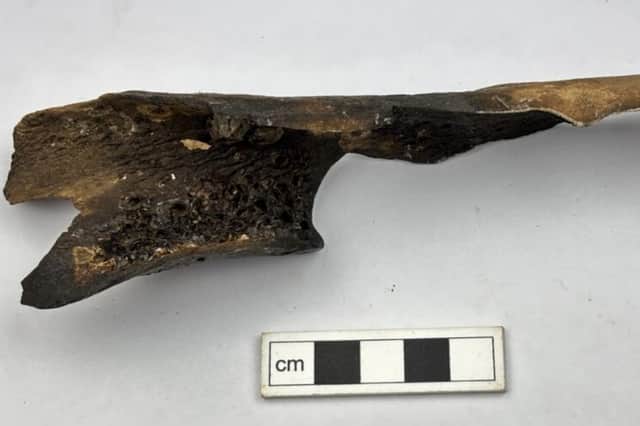
Around 13 per cent of the bones bore evidence of butchering, sawing or chopping, with such marks found on almost half of the fragments derived from cattle, sheep and goat.
Experts believe the cuttings were made by a modern electric saw, raising the possibility that at least some of the remains were sourced from a butchery.
But the local butchers’ isn’t the only place the unknown collector may have retrieved bones for their hillside assemblage.
Two of the long mammal bones were found with limpet shells attached, suggesting they had been spent a long time in seawater, while other fragments showed signs of animal gnawing.
To deepen the mystery, radiocarbon dating - a technique used to establish the age of organic material - produced some intriguing results.
A fragment of horse bone was dated to 1811, while a cat bone, believed to have belonged to either a pet or a stray, returned a date of around 1950.
Even stranger is the bones showed varying degrees of weathering, indicating they had been collected and left on the hill at different points in time, rather than all at once.
“The location itself is perhaps the greatest clue,” said Kelsi McDaniel, HES’s senior cultural resource advisor for Edinburgh.
“Arthur’s Seat is undoubtedly a very busy area with several footpaths. However, Crow Hill is not somewhere a person would casually carry hundreds of bone fragments simply to dispose of them.
“There are much easier ways to dispose of the bones if that had been the only goal. The effort required suggests the site held a particular significance for whoever left them there.
“The location must have been selected for a specific reason.”
Bones carried ‘traces of craft and creativity’
While the majority of the bones were damaged in the fire, experts were still able to identify “very clear” evidence of human modification.
One of the most intriguing discoveries was an unidentified mammal bone, around five centimetres long, found painted with black and white stripes.
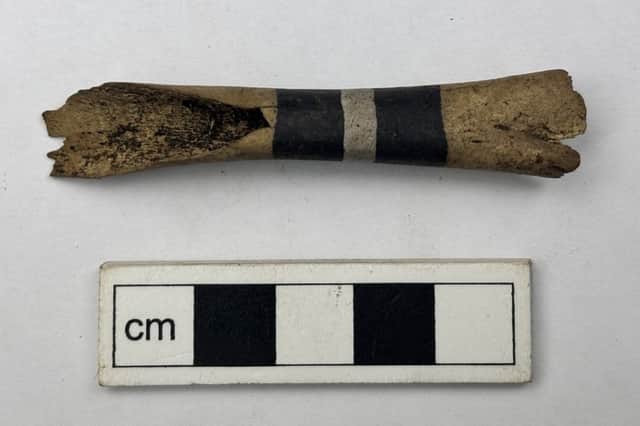
Another bone, believed to be the femur of a sheep or goat, was found with red fingerprints, while others showed evidence of drilling or coring.
While the modified bones remain a mystery, experts suggest the bones may have been used in “some kind of craft activity” before being deposited on the hill.
‘Edinburgh’s newest mystery’
A site of human activity since prehistoric times, this latest mystery is far from the first to emerge from the slopes of the volcanic hill.
The discovery of 17 tiny coffins, each containing a small wooden figure, on the north-east side of the hill in 1836 remains one the city’s most intriguing and baffling tales.
At the time, the discovery fuelled sensational speculation among residents and newspaper journalists, with some attributing the strange objects to witchcraft and demonology.
The coffins were examined further in the 1990s, revealing the figures were most likely made by a shoemaker and deposited on the hill only around six years before they were discovered.
For Ms McDaniel, the two mysteries bear an uncanny resemblance.
“Despite countless theories, nobody knows for certain who made them or why they were left hidden on the hillside,” she said.
“Both finds feature an unknown creator, a dramatic location and a story full of unanswered questions.”