
Helping young artists transform our city
In the heart of Edinburgh a once-empty office block at 45 Leith Street has been transformed in the most unexpected way. No longer lying unused, its rooms are now alive with canvases, sculptures, and a thriving community of more than 100 artists and recent graduates.
In August I was invited by Scottish Contemporary Art Network (SCAN) to visit the latest project by the arts charity Outer Spaces at 45 Leith Street, a temporarily empty office block on Leith Street in central Edinburgh, where the Edinburgh Art Festival Pavilion was also hosted.
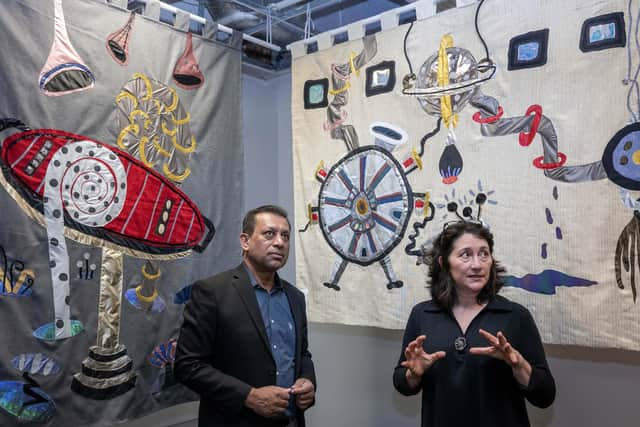

Over 100 artists and recent art graduates currently have free use of studio space in the building, forming a unique community of artists right in the city centre. On the top floor, The Cube Studio Programme is taking this idea further, creating a dynamic space for both making and showing contemporary art through a series of guided tours. The programme supports artists at various career stages and from a wide cross-section of the Outer Spaces network.
Director Shân Edwards told me more about Outer Spaces, which was set up in 2021 in a direct response to the effects of the covid pandemic on artist's communities and livelihoods. The organisation takes on leases for empty commercial property across Scotland and makes it available for artists to use for free while landlords are planning redevelopments or new uses. The artists use the properties as temporary studio and project spaces and Outer Spaces supports the network with selected residencies, commissions, and public exhibition opportunities. This approach is vital for artistic career development, research and experimentation, and encouraging collaboration and cultural renewal in the arts sector.
The Outer Spaces model responds to the changing face of our cities post-pandemic, with a new vision of an artist-centred infrastructure for the arts. Outer Spaces now supports over 1000 artists in properties spanning 13 local authority areas; a national network that is breathing life into once vacant commercial properties across the country. Their presence not only helps to maintain the fabric of the buildings, but also the cultural identities of our towns and cities. Whilst touring 45 Leith Street, I met artists Hanna Lehtinen, Pandora Vaughan and Hattie Quigley. They all told me that Outer Spaces is an important part of the visual arts ecosystem.
I also met Outer Spaces’ Programme Lead Tiffany Boyle, who told me: “After graduating from art college, many artists may not know what their next steps will be. Where will they find support? How will they find a studio to continue to make work? The Outer Spaces model helps to remove financial barriers for these new artists, affording them the time, space and community to keep on developing their work.”
Working in partnership with universities and art schools across Scotland, Outer Spaces is also supporting graduate retention in cities where artists are often pushed out due to prohibitive studio rent and living costs. So far, the programme has offered free studio spaces to 110 early career artists in the cities where they studied, with access to communities of artists and new networks. Supporting artists to stay where they studied keeps hold of the creative vitality that our cities have helped to nurture and allowed to flourish.
“Our use of vacant properties in transforming urban areas is supporting art collectives and communities, developing new models of inclusion, innovation and sustainability,” Shân Edwards told me. “Supporting artists with not only space, but opportunities to progress and be ambitious is a vital part of a sustainable arts ecology and the cultural landscape of our cities.”
My visit to Outer Spaces was part of Scottish Contemporary Art Network’s initiative to invite MSPs to visit studios, galleries, venues and creative production facilities across Scotland. Here, MSPs find out first-hand about the important role of artists and arts organisations in their constituencies and regions. Politicians are then encouraged to take that message back to their parliamentary offices, where new knowledge could make a difference to communities across the country.
At a recent event as part of The Festival of Politics, we talked about Dreaming of a Fairer Future for Culture. A moving film by Indra Wilson, commissioned by Culture Counts, shared voices and aspirations of some of the people living in North Glasgow: “I am a son, a brother and an uncle”. “I am the guitar that my mother gave me”. Everyone has a story and artists and creative minds can help us to tell them in a meaningful way. Artist and writer Harry Mould urges us to remember that culture, “isn’t caviar, it’s salt. You sprinkle it on everything because it brings out the flavour”. The event focused not just on creativity but also on equity, shared resources and seeing artists, art workers and organisations as viable partners and collaborators.
Meeting with creative people and organisations reminds me that through community, there is progress. Culture and creativity really do improve our quality of life and creative projects transform local communities and towns – even city centre streets like Leith Street, where artists are busy creating new work in the very heart of Edinburgh.
Foysol Choudhury is a Scottish Labour MSP for Lothian