
Post-graduate courses in Edinburgh: boost your career potential and take your skills to the next level

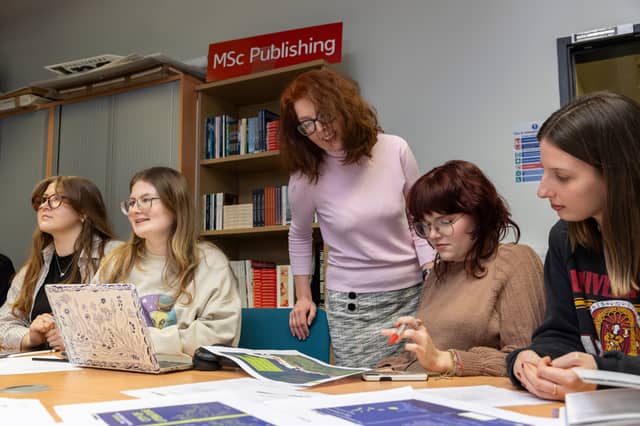

Looking for post-graduate courses in the city? Edinburgh Napier University has a huge range of courses – discover the new additions for 2027.
There’s a reason this city university is ranked in the top five modern universities in the UK for career prospects according to the Guardian University Guide 2027; it’s also among the best for graduate prospects in the latest Sunday Times Good University Guide.
This is a university focused on helping you develop the skills which employers want from their future workforce.
With a huge range of courses – including new additions in cutting-edge areas – they are here to help you get ahead.
Find out more at the upcoming open evening at Merchiston Campus on 19 November. Book your spot on the website today.
World-leading research helps you to learn more
Research matters here: there are 17 Research Centres at Edinburgh Napier University, all driving forward applied research in areas from cardiovascular health or conservation to cybersecurity, AI and robotics. In fact, it’s the leading modern university in Scotland for research power and research impact in the current UK Research Excellence Framework.
This focus on furthering knowledge along with strong links to industry helps to ensure that its post-graduate programmes are aligned to what employers are looking for right now.
It’s also a great place to study, retaining its top spot as the number one modern university in Scotland, according to The Sunday Times.
Whether you are thinking about continuing your studies here in Edinburgh or improving your skills and knowledge, you can choose from more than 100 masters courses across business, fine arts, computing, healthcare, applied sciences and engineering. There are flexible start dates in January and September 2027 to ensure you can study as it suits you.
This year, new programmes have been added, including courses in Creative Documentary Filmmaking, Marketing with Sustainability, Robotics and Autonomous Systems Engineering, Sound Design and Clinical Exercise Physiology.
Read on to find out more about some of these unique options in the heart of the city.

Taking a multi-disciplinary approach to learning about AI and leadership
One of the new courses which has been attracting plenty of attention is the MSc Human Resource Management with Artificial Intelligence. Programme lead Malcolm McGregor says the timing for the course is ideal as businesses grapple with the rapidly evolving technology and how best to harness its benefits.
“We're in a period of massive flux and change, so we wanted to produce an MSc that gives our students a thorough grasp of the AI revolution as well as the traditional education that organisations are looking for,” he explains.
While based in the Business School, the course has a strong emphasis on computing to offer the very best of knowledge from Edinburgh Napier University’s experts.
“The team here are really aligned for Human Resource Management and Computing,” says Malcolm. “We all want our students to excel, and we all want the best possible jobs that you can get. And given that the jobs market is so difficult at the moment, our role to help our students has never been more important.”
As a result of the collaboration across the university, students will cover AI and the history of its development along with data analytics in a uniquely in-depth approach.
“We are trying to give students competence in understanding and not being afraid of where it comes from and how it works. If you look at all the research on confidence, that evolves when people are competent.
“This is a direct attempt to give people a thorough grounding, show them the edge, show them the depth, show them the mathematics where it all comes from, then enable them to see the tools that are available to them that they could use.”
As many organisations “are still coming to terms with what it means”, this course offers you the chance to learn about the foundations of AI and be able to offer future employers. Key to this is an in-depth understanding of the technology that will allow you to speak with confidence about this topic. “We would want our students to be able to contribute to conversations with knowledge that perhaps others in the room hadn't really thought about. We need them to bridge the gap between leading in the organisation and using the technology effectively.”
There are few courses that will offer an equivalent immersion in the infrastructure behind AI: “We try to keep ourselves as up-to-date as possible and responsive to environments, the stuff that's going on now. How do you choose? How do you work out which one is going to be the best for your organisation? he adds.
“We pride ourselves in having our finger on the pulse. We listen hard. We read and look and research in all of these areas that are of great interest to businesses.
“We're all about employability. I want students to leave and get top jobs, and they've got to be prepared. They've got to be ready. Organisations are asking, ‘What do you know about AI? How are you using AI?’ So I want our students to leave university and interviewers to say, ‘Wow, this is really useful.’”
‘There are job opportunities for those who study lighting design’
The MA in Lighting Design has been resurrected for 2026, due to popular demand, and programme lead Sarah Taylor says it offers a lifeline for those looking to get into the creative industry with a formal qualification under their belt.
“It's important for Scotland to have an option for MA Lighting Design and it gives undergraduates the opportunity to develop their knowledge and skills and provides a potential pathway into the industry,” she says. “There are very few MA lighting courses within the UK. But there are really exciting opportunities in lighting. The industry offers career opportunities in Edinburgh, across Scotland and internationally
The one-year course runs full-time from September 2027; there is also a part-time option. And Sarah says it is a natural progression “for graduates from a range of creative disciplines including interior design, architecture, exhibition design or theatre for example, even product design, or graphics”.
Importantly, the course offers students the opportunity to network and make connections with industry professionals who have been enthusiastic about supporting the course. “The support from industry has been fantastic,” says Sarah. “Since we've relaunched, they've been opening their arms to us.” That includes global engineering consultancy, WSP, which has supported the development of the curriculum and is also contributing directly to teaching through module delivery.
“If we've got support from industry, we must be doing something right. We have quite a robust industry in Edinburgh and the wider area so students will have opportunities to build connections in different ways, whether it's being taught by an industry professional or attending an event on campus.”
They have teamed up with the Society of Light and Lighting and organise industry events that allow students to network, meet manufacturers and hear from lighting professionals.
“We're also drawing on the relationships that we've built up over the years in industry so we can go on special visits that support students’ learning in particular areas like sustainability and wellbeing. These visits give students the opportunity to expand on studio-based exploration in an industry setting, using specialist equipment. They also get to see what companies offer.”
The course will also help local companies connect with emerging talent, says Sarah. “It gives industry an opportunity to see which students they might want to work with them on a work placement or potentially employ in the future. It's the ideas that are really important, it's the creativity that they're looking for Our industry partners have an opportunity to see what types of work students are producing and whether they might be suitable to work with them.”
The MA offers a specialist academic route into lighting design that hasn’t always been available, and it’s exciting to be at the forefront, says Sarah. “Because there are so few courses that specialise in lighting, a lot of designers fall into the industry and we want to change that,” she explains. “We want to say, ‘Come and study with us and develop the skills and knowledge to help you enter the industry.”
It also offers the opportunity for those already working in lighting to gain an academic qualification and further develop their professional practice.
Information Science course designed by industry
The new MSc Information Science builds on the considerable research and professional expertise of teaching staff in this niche but vital topic. The course will prepare you for work in information departments, research institutions, publishing and in archives, libraries and museums. Some students go on to records management and business analysis, others in web development to help with information architecture.
Programme leader Frances Ryan stresses that it is not all focused on the digital era. Information science is about information. It’s not necessarily the words written on a piece of paper; it can be things that you do and things that you can sense and smell. Increasingly, people talk about information as what exists online, but books still exist, letters still exist, journals still exist. All of those things are sources of information, and part of information science is looking at how we categorise, understand, and use those pieces of information.
Students are also encouraged to engage critically with the subject and to question the assumptions underpinning information systems, including the biases that can exist within established methods of organisation and classification.
“Our lecturers bring theory into the classroom and show how it works in practice. Class sizes are small enough for dynamic discussions, with students sharing their own experiences and perspectives. There’s a lot of opportunity for meaningful engagement and debate.”
The one-year course, which is working towards accreditation from industry body CILIPS, offers start dates in January or September 2027. It was developed in collaboration with industry and third sector partners to help design a course that would give future employees the skills they wanted to see.
“When we designed the MSc, we consulted widely. We ran focus groups and interviews with government organisations, third-sector bodies, corporate employers, librarians, information specialists and information scientists from across Scotland. We asked a simple question: if you’re hiring someone with this degree, what knowledge and skills do you want them to have?
“The programme was built specifically to meet both the requirement for accreditation and the needs of employers.”
Small class sizes mean that there is a lot of support available, particularly to help shape your own research. The course is led by those working in the university’s Information Science Research Group “so the people who are supervising your MSc dissertation and the people who are teaching your modules are information scientists”.
“There are opportunities for students who want to move directly into industry, and there are opportunities for those who want to continue into research. Whatever direction students choose, we’re happy to help open doors and support them in taking the next step.”
In addition, she would love to hear from anyone working in the sector in Edinburgh – just email [email protected]
Come along to an open evening to find out more
Anyone interested in discovering more about these new programmes, or one of the many taught postgraduate qualifications offered by Edinburgh Napier University, can attend an open evening to have all their questions answered.
Visit the website to register your interest in the event at the Merchiston Campus from 5pm to 7pm on Thursday, 19 November.