
Hibs’ forgotten triumph: How Paul Kane, John Collins and Co conquered 1990 Tennent’s Sixes

As the cult indoor tournament returns after 33 years this weekend, we revisit Hibs’ memorable run to glory in 1990
There was something gloriously uncomplicated about the Tennent’s Sixes. For one weekend in January, Scottish football abandoned its expansive pitches and squeezed itself into an indoor arena, where the space was tighter, the goals came quicker and the old rivalries remained every bit as fierce.
For Hibs, the 1990 tournament delivered a rare piece of silverware – and one that has acquired an added charm with the passing of time.
The seventh staging of the tournament took place at the Scottish Exhibition and Conference Centre (SECC) in Glasgow on January 28 and 29. Ten Premier Division clubs competed for £16,000 in prize money, with the event promising two days of fiercely competitive football played at breakneck speed.
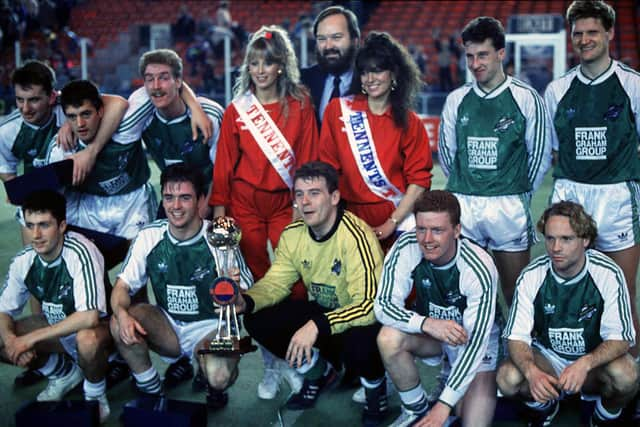

Hibs, led by assistant manager Peter Cormack and coach Andy Watson, ventured along the M8 and quickly established themselves as a difficult side to beat. Their group featured Rangers, St Mirren, Dundee and Dundee United, but Hibs emerged with a blemish-free record.
They drew 0-0 with Rangers, winning 4-2 on penalties, before defeating Dundee United 5-1, courtesy of a Paul Kane-inspired hat-trick. Kane then struck both goals in a 2-0 win over St Mirren, before a 3-0 victory was recorded over Dundee. Four games, four wins and just one goal conceded saw them progress as group winners.
There was a particular irony to their efficiency. The Sixes were designed to encourage attacking football, yet Hibs' route to the knockout stages was built on a defence that proved remarkably stubborn - a valuable asset in a format where a single lapse could prove decisive.
Then came the drama.
The semi-final brought a fixture that required no introduction - an eagerly-anticipated Edinburgh derby against rivals Hearts, who had finished as runners-up in Group Two.
There was little to separate the two sides on the night, with the match ending 1-1 after Tosh McKinlay’s opener was cancelled out by a red-hot Kane. Hibs prevailed 2-1 on penalties, with John Collins converting the decisive spot-kick after Andy Goram had saved efforts from John Robertson and Gary Mackay.
It was precisely the sort of contest that demonstrated why the competition could be so compelling. In a six-a-side venue, there was little room for caution and even less room for error.
In the other semi-final, St Mirren drew 1-1 with Motherwell before prevailing 6-5 in another dramatic penalty shoot-out. It set up an intriguing final between two sides who had already met in the group stage.
By the time the final began at 9.55pm on Monday evening, the Sixes had already produced a whopping 75 goals across 22 matches. Hibs now faced one final obstacle standing between them and the trophy.
They did not buckle in front of a 7,500-strong crowd. Hibs overcame their Paisley opponents for a second time, winning the final 2-0, with Kane and Collins getting their names on the scoresheet. Kane had been central to their campaign throughout, finishing as the tournament’s leading scorer with eight goals.
Cormack: ‘Over the two nights we were the best side’
The result gave the Easter Road club their first – and ultimately only – Tennent’s Sixes title to date. It also meant they joined an eclectic list of winners that already included Rangers, Hearts and Aberdeen.
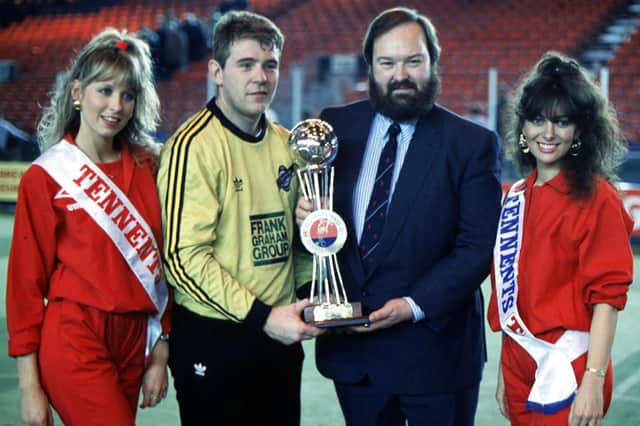
Reacting to the triumph, Cormack said: “It was a tremendous victory for the lads. Over the two nights we were the best side, playing some excellent football, so it was nice to achieve something. I was delighted for the players and it will give them a boost away from the pressure of Premier League football.
“Andy (Goram) was amazing. What an achievement to come through a tournament like this losing only two goals. He’s a character who loves to compete. Kano was tremendous. He has an eye for a goal and he did very well.”
Asked whether Hibs were worthy winners — and if their triumph meant they could skip training the following day — shot-stopper Goram replied: “Aye, we’ve had it hard enough over the last two weeks, so it’s nice to pick up silverware. We had the perfect combination with Kano up front scoring and our defence not letting many in at the back. Obviously, you need a bit of luck as well but winning should give us a bit of a lift.”
Their victory came during an era when the Sixes were far more than a novelty. The tournament was televised, attracted sizeable crowds and gave supporters the chance to see Scotland’s leading players in an unfamiliar environment. The fast-paced format altered the rhythm of the game: midfielders had less territory to patrol, strikers were constantly involved and defenders had nowhere to hide.
There was also an element of theatre. The Sixes occupied a curious space between serious competition and sporting entertainment, but Hibs’ memorable run in 1990 showed that the players treated it as considerably more than a gentle kickabout.
The statistics underline just how accomplished their campaign was. Hibs scored nine goals in the group stage while conceding only one, finished top with eight points and then negotiated the two biggest games without conceding from open play.
The tournament itself produced an average of more than three goals per game. Yet when it mattered most, Hibs found another gear defensively.
There was no grand European stage attached to the triumph, nor a long succession of years in which the trophy was defended. The Sixes disappeared after 1993, bringing a nine-year stretch to an end and leaving its winners with something increasingly rare in modern football — a competition remembered as much for its atmosphere and eccentricity as its results.
For Hibs, though, the 1990 victory remains an enduring part of that history. 36 years on, a legends edition of the Tennent’s Sixes has returned to the Scottish football calendar, resurrecting memories of a competition in which former opponents became indoor combatants, packed arenas replaced traditional terraces and the difference between victory and elimination could come down to a single goal — or a single penalty.
Hibs’ triumph was built on both. They were unbeaten and, in the strange little world of the Sixes, that was enough to be crowned champions. Perhaps that is why the memory has endured: for two nights in Glasgow, the game was smaller, faster and noisier, but winning still mattered.
This year’s tournament takes place at Braehead Arena on October 3 and 4, with live coverage on Premier Sports.
Hibs’ 1990 Tennent’s Sixes team: Andy Goram, Graham Mitchell, Alan Sneddon, Billy Findlay, Pat McGinlay, Paul Kane, Neil Cooper, John Collins, Brian Hamilton, Michael Weir