
Hibs formation options in focus as David Gray 'tactical flexibility' talk faces UEFA Conference League test
Analysing the alternatives as Easter Road side look to overturn 2-0 deficit
There’s so much to tactics than formations. Even if some of the remedial-level debate surrounding Scotland’s performance at this summer’s World Cup would have you believe otherwise.
As Hibs prepare for their first competitive home match of season 2026-27 with the pressure already mounting, however, Easter Road regulars will be keenly watching the opening minutes of tomorrow night’s clash with Malisheva for indications of shape and – more importantly – game plan. Having taken note of David Gray’s comments about tactical flexibility during pre-season, there will definitely be interest in the details of how his team line up.
Repeat the 3-4-2-1 formation that may – or may not – have been a factor in last week’s flat-lining performance in Pristina? Or switch things up, as Hibs did for brief spells during that 2-0 defeat? Let’s consider the factors at play.
Game state
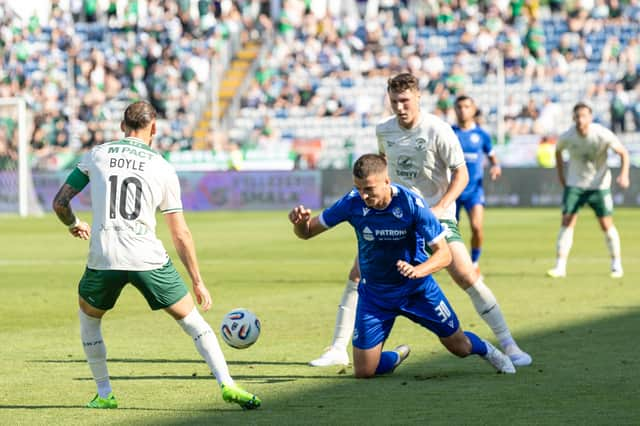

You’re two goals down. More importantly, the visitors – a team in dreamland after the greatest result in club history – are sitting on a two-goal cushion against opponents from a much stronger league.
Malisheva have to be a little bit nervy about this one. Although they’ll fancy their chances of hitting Hibs on the break, as they did for that killer second in Kosovo, don’t expect them to go with the two up front – backed by a number 10 – that saw them carry such threat in the home leg.
Which begs an obvious question of Hibs. Do you need a back three to mark one striker?
Stick or twist
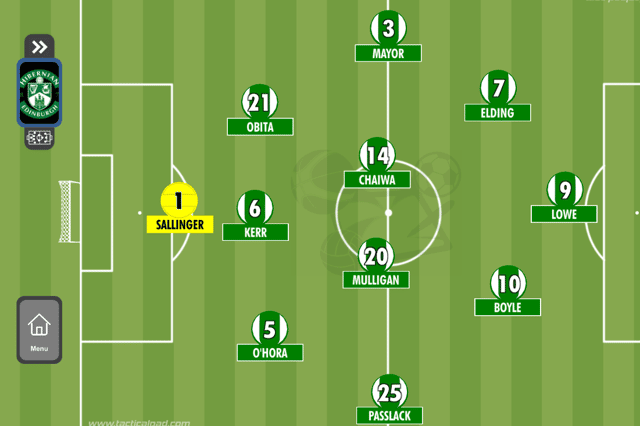
The conservative choice is to remain with the familiar, which is some variation on the 3-4-2-1/3-4-1-2 used in the first leg (see photo 1). It’s a system Hibs know very well and, if you get the right combinations going in the final third, it’s plenty attacking enough for anyone’s tastes.
The keys, if Malisheva play just a lone striker, include getting your central defenders on the ball and moving forward to break the lines. Wingbacks must go high. And there have to be plenty of runners beyond the centre forward(s), depending on exactly how you line up in the final third.
Personnel issues
Grant Hanley did not look particularly great, even in a team of underperforming players, as Hibs lost that sucker of a second goal last week. If Jason Kerr doesn’t start, the summer signing will wonder what he’s done wrong.
A lot depends on the fitness of Jamie McGrath and Callum Wright, either of whom would be a welcome addition to the team. Both are capable of slotting into a couple of different roles.
You almost have to give Nathan Lowe a chance, meanwhile, to make amends for those two poor misses in Pristina. Depending on formation, this could mean someone dropping out of the front line – either Martin Boyle or Owen Elding. That would be a really tough call.
A new-look line-up
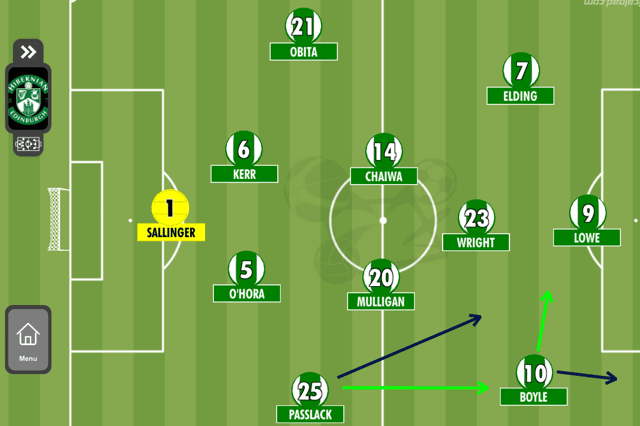
Everybody in football loves a 4-2-3-1 (see photo 2). Honestly, in coaching circles, it’s as popular as the idea of melting down the nation’s VAR equipment.
Gray has flirted with the shape. Which is not, on its own, the answer to all that ails a team.
Everything comes down to what players do from, rather than in, their positions. Movement is everything.
In the case of Hibs, you don’t want Martin Boyle hugging the right touchline – unless it’s to create space for Felix Passlack on the underlap. Or they reverse roles, with Boyle driving infield and Passlack playing as a winger.
As with any formation relying on a lone No. 9, the danger is in the striker getting isolated. Get this right, though, and you can attack from all angles, with different sorts of weapons, while maintaining a solid base.
No easy answers
For what it’s worth, Hibs should be able to line up in just about any formation and still get the job done tomorrow night. Forget last week, which was an aberration. With the exception of one or two technicians, the home side should have better players in virtually every position.
But Malisheva did pose some tricky questions last week. They didn’t let Hibs build into a pattern of play.
Gray being prone to rely on one or two similar formations, regardless of how much variation there might be within the basic shape, has become a bone of contention for some fans who mistake consistency for lack of imagination. Not that he can do much if he doesn’t have important players fit, of course.
In this very specific instance, though, a change might add a degree of oomph to the Hibs attack. And create just a little bit of doubt in the minds of visitors who cannot be sitting comfortably on their lead.
John Greechan is a coach with a UEFA B Licence and holds a Certificate in Advanced Tactical Analysis from Barca Innovation Hub Universitas.