
300th anniversary of the local man who discovered deep time - Donald Anderson
This year marks the 300th anniversary of the birth of James Hutton, one of the greatest figures of the Scottish Enlightenment and the man widely regarded as the father of modern geology.
Born in Edinburgh on 3 June 1726, Hutton studied medicine but was a polymath who pursued interests ranging from farming and chemistry to meteorology and geology. It was his practical experience of working the land, combined with painstaking observation of Scotland’s rocks - including Arthur’s Seat, that led him towards his revolutionary theory of the Earth.
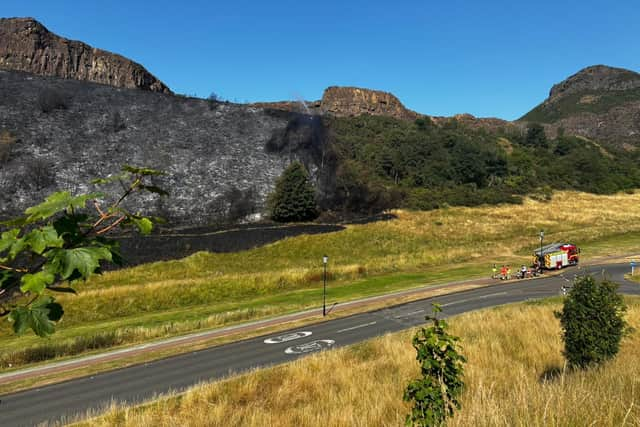

Hutton realised that the landscape had been created through a continuous cycle. Mountains were gradually worn down by wind and water; the resulting sediments accumulated beneath the sea, hardened into rock and were eventually raised to form new land.
This principle revealed that the planet must be vastly older than generally believed. At Siccar Point on the Berwickshire coast, Hutton observed nearly vertical layers of ancient rock overlain by younger horizontal strata. These formations recorded successive ages of deposition, upheaval, erosion and renewed deposition. The time required was so immense that Hutton famously concluded that the Earth showed “no vestige of a beginning, no prospect of an end.”
The challenge of making this discovery is easily underestimated. Charles Darwin later faced a comparable challenge in explaining how the extraordinary diversity of life could arise through natural selection. Both men had to infer processes operating so slowly that they could not be witnessed within a human lifetime.
Unlike Darwin, Hutton had no equivalent Wallace figure arriving independently at the same explanation. He pieced together the theory of deep geological time largely alone, without modern geological maps, established classifications or any knowledge of radioactivity and radiometric dating.
Hutton’s weakness was not his science but his communication. His original Theory of the Earth was dense and repetitive. Even dedicated geologists don’t wade through the original text. I didn’t even try. Hutton possessed one of the most remarkable scientific ideas of the age but lacked the ability to explain it clearly to a wider audience.
That task fell to his friend and fellow genius – they were ten a penny in the city back then, John Playfair. In Illustrations of the Huttonian Theory of the Earth, published in 1802 after Hutton’s death, Playfair translated Hutton’s arguments into lucid and persuasive prose. His intervention enabled Hutton’s ideas to achieve the recognition they deserved and helped ensure their influence upon later geologists, including Charles Lyell, whose work in turn shaped Darwin’s thinking.
Hutton belongs to the extraordinary intellectual world of Enlightenment Edinburgh, alongside figures such as David Hume, Adam Smith, Joseph Black and James Watt. Together, they helped invent the modern world by insisting that nature, society and human behaviour could be understood through observation, evidence and reason.
Hutton’s achievement was to give the Earth a history. He showed that beneath familiar landscapes lay a past of unimaginable depth—and gave science the time it needed to explain both the planet and the evolution of life upon it.
Three hundred years after his birth, Hutton’s insight remains fundamental to our understanding of the natural world. His tercentenary offers us an opportunity to celebrate not only the father of modern geology, but one of our most remarkable thinkers and a genius who helped usher in the modern age.