
Holyrood elections 2026: Teenagers quiz Edinburgh candidates at special hustings
Artificial intelligence, online disinformation and net zero were among the topics when 16-18 year-old voters got the chance to question Edinburgh candidates at a special hustings ahead of the Holyrood elections.
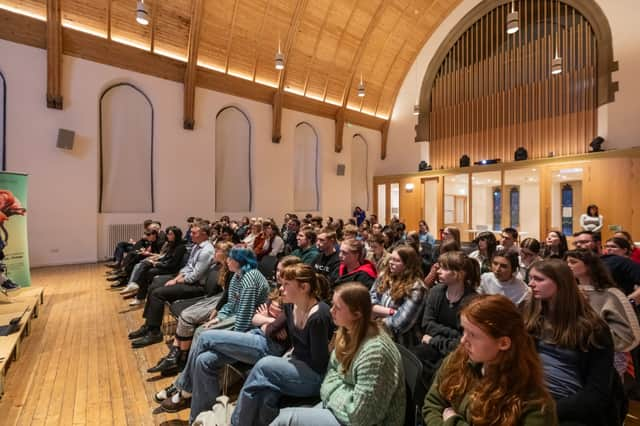
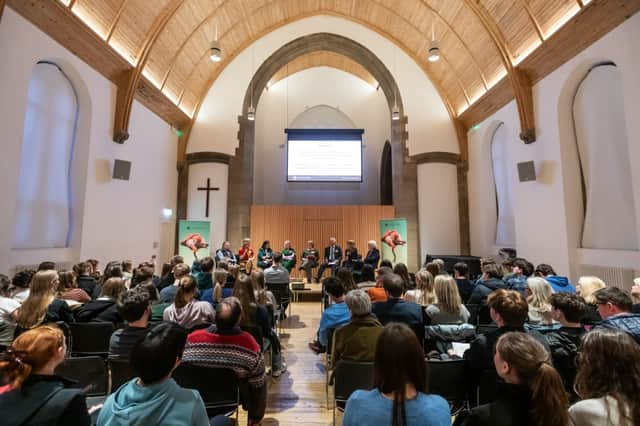
The event, entitled The Future Speaks, was organised by James Gillespie's High School in partnership with the Edinburgh Futures Institute.
And an audience of around 100, including pupils form several different schools, heard seven candidates trying to address their questions.

Mairi from Portobello High School asked how the candidates would ensure graduate jobs remained competitive and were not taken over by AI.
Liberal Democrat Jane Alliston Pickard said AI was "coming at us like a tsunami" but experience showed that technology often over-promised and under-delivered. "And when it under-delivers human resourcefulness and flexibility is the thing that fills in."
And she said people in future would have to keep retraining. "We will make sure FE colleges can offer upskilling when you need it for your career - and I think we will all be needing to do that."
Independent Jeremy Balfour said: "I think in the next 20 years we are about to go on the biggest journey since the industrial revolution. And I'm almost convinced that whatever job you leave school with today, you will not be doing that job when you retire because the market is going to change unbelievably.
“Maybe we don't need as many people to graduate from university as in previous generations. I've been blown away over the last 10 years at the number of apprenticeships there are out there and apprenticeships can be a way in and give you a much more secure job."
Simita Kumar, from the SNP, said the jobs her generation had been prepared for at university no longer existed. AI was "not to be feared" but it was important to understand how to apply AI to healthcare and other areas.
Reform's Gary Neill claimed a strong economy was they key. "There is so much opportunity for graduates now that AI is here but that will only be realised if we have a strong, wealth-building economy."
Labour candidate Katherine Sangster said her party wanted to "shift education into skills that aren't necessarily something that could be done by AI" as well as also teaching how to use AI and how to be critical of AI.
She said: "We're going to introduce a digital skills passport into classrooms, we're going to work with businesses so you're learning skills that businesses need and we're going to start to shift the economy into apprenticeships."
Conservative Sue Webber said young people might be scared they were not going to get a job when they finished university. But she said: "Employers will know less about it than you do, unless you're going to work for a big global corporation. It's small and medium sized businesses that are willing to give the graduates their first chance and they will be looking for your expertise and your capability to harness it."
But Kate Nevens of the Greens took a different stance. "I think AI s fundamentally harmful to work and workers, it's driving jobs away, lowering wages, making it harder for graduates to get those entry-level jobs, it's replacing human judgement and creativity with unreliable systems, it's deskilling us, it's making us less curious."
She argued it also reinforced existing social injustice and inequality. and should be resisted as much as possible. "On the positive side, Greens would work with students, graduate and workers ro develop alternative technologies that are socially good, that are sustainable and about our collective wellbeing."
The candidates were asked what they would do to help young people differentiate between true and false in social media, given an Ofcom report showing a dip in confidence among 16 and 17 year-olds about what they were seeing online.
The SNP's Simita Kumar urged people to approach AI in the same way as they would writing up research and having to reference sources. "We have to apply critical thinking - what s the source of the information you are getting? Is this absolutely correct? Where else could I go?"
Conservative Sue Webber said people should be taught digital literacy from an early age to help them spot fake content. And she said the Tories supported a ban on mobile phones in classrooms to allow "a much more traditional learning environment."
Green Kate Nevens endorsed the need for critical thinking and digital literacy. And she said the Greens were calling for online platforms to be classed as publishers os they could be held to account for what was posted on their sites.
Independent Jeremy Balfour said there was a limit to what MSPs could do since most IT and technology powers were reserved to Westminsters. But he pointed to education. "I think we need to go right back to primary school and it needs to be part of the core syllabus all the way through their education."He said he was wary of banning things.
But he said: "I think we need to look at the use of mobile phones and the use of technology generally in our schools. We all now use our ipads - we don't write things except when it comes to exams."
Gary Neill from Reform said he thought among 16 and 17 year-olds there was "a lot of potential and common sense and ability to think things out". And he said: "I'm very sceptical of any government or politician who says you can watch this or not, listen to this or not, you can't read this any more."
Lib Dem Jane Alliston Pickard said said the dip in confidence meant that 75 per cent of 16 and 17 year old had confidence in what they were seeing online. "That slightly startled me. I would like to see it being lower. I would like to see us all being a little bt more cynical as well as curious - I think that would be a healthy way to go."
Labour's Katherine Sangster said she was more worried about older people and disinformation. "I've worked with lots of young people and I have every confidence in the ability of our young and I'm very positive about the future of this country if it's in your hands."
She said after campaigning for a year, she believed the misinformation which people were seeing online was a real issue. "People are coming to the door and they are telling me things that are just not true. It's driving fear, polarisation an hatred in our communities and we have to find a way of stopping it."
Answering other questions, Labour and the Lib Dems backed the target of net zero by 2045; Reform said net zero was crippling the economy; the Greens said oil and gas extraction should end immediately; and the Tories called for the life of Torness nuclear power station to be extended and the introduction of small modular nuclear reactors.
Simita Kumar from the SNP said she was born and bred in Fiji and said neighbouring islands were disappearing. "Climate change is so real, there are so many people who do not have a home any more, so we cannot keep delaying - we are in the critical moment."
At the end, one pupil spoke on behalf of all the young people who had been involved in putting together the event.
He said: "Our message is simple: Don't forget about us, the people who will live with the consequences of political choices - include us, trust us, recognise when the future is speaking, then listen, then act."