
Tactics Zone: How can Hibs beat bogey team Buddies? Keys to breaking down dangerous St Mirren in Paisley
Stephen Robinson’s team make opponents scrap for every inch - so where are the gaps David Gray can exploit?
It’s hard for anyone to spring a surprise in a competition as claustrophobic as the Scottish Premiership. With repeat fixtures against the same opposition crashing together in one congested calendar, there isn’t a lot of time for tactical reinvention or dramatic switches of philosophy.
What can Hibs expect when they head to Paisley for this weekend’s SPFL game against St Mirren, then? Variations on a theme. A hard old slog of a game, with the margin between success and failure inevitably measured in pounds per square inch of effort and strain.
When these teams met earlier in the season, in a 1-1 draw at Easter Road, Hibs were ultimately undone by a messy offside line at a free-kick. Never easy to get spot on, they somehow allowed an opponent to get lost in the morass of bodies lining up on the edge of the box – and paid the price for one defender dropping half a yard too deep, half a heartbeat too soon.


If that’s a scenario that probably sums up the importance of concentration in a league where players get no time to think, it also speaks to the mental sharpness of Stephen Robinson and his team. Physically strong in key areas, despite Robinson’s protest about having one of the smallest back fives in the league, and rarely prone to building patiently when a ball into the opposition final third is an option, they’re smart cookies who know how to play the percentages.
When it comes to disrupting the opposition build-up, St Mirren will wait for the right trigger to press. And then snap into action, looking to force turnovers high up the pitch.
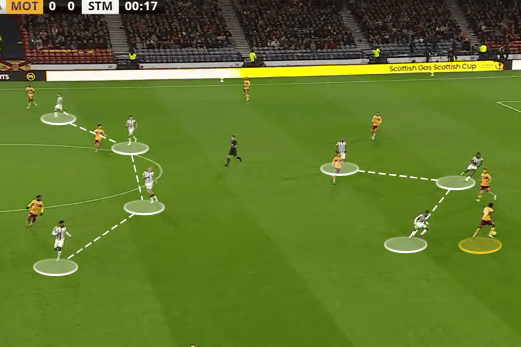
They do have a tendency, though, to overload one side of the pitch and get drawn to the ball. If they leave the sort of gap identified in the photo below, a quick switch of play will expose loads of space.
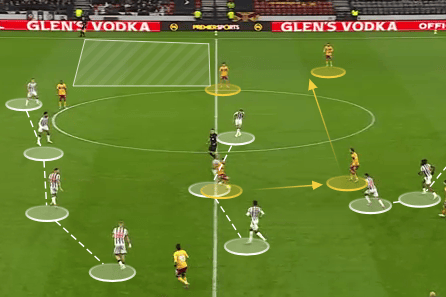
They’re a threat at set pieces. And there is enough movement about their front line to create gaps, should defenders get drawn out of position.
In terms of specifics, corner kicks from the left tend to be aimed at an area between the near post and the penalty spot. From the opposite side, they look to bring the back-post area into play.
Goalkeeper Shamal George rarely goes short when there’s an option to deliver the ball into enemy territory. Every phase of play is a scrap.
Normally lining up in a 3-5-2, Robinson did switch to a 4-4-2 for the weekend’s Premier Sports Cup semi-final win over Motherwell at Hampden. That game as a clash of styles, with the Steelmen finding that all the plaudits received for artistic flourishes counted for nought against the battling Buddies.
Like most teams, they’re vulnerable to the right sort of pressure. Gray could go with an all-pace attack, pairing Thibault Klidje with Martin Boyle, just as he did against Livingston last weekend.
Then again, Kieron Bowie’s physicality might prove an asset in a game that could see possession turn over quickly and often. Either you play over and around St Mirren. Or run over the top of them.
John Greechan holds a UEFA B Licence in coaching and a Certificate in Advanced Tactical Analysis from Barca Innovation Hub Universitas.